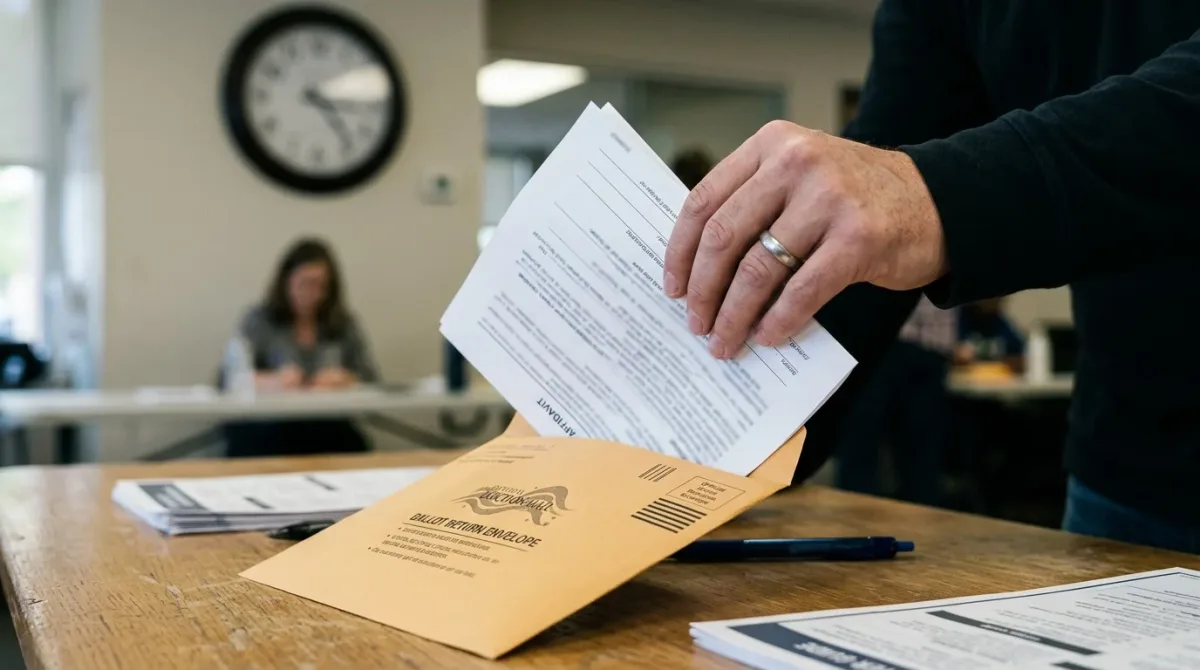
Ballot curing is the process that lets a voter fix a signature problem on a mail ballot after it has been flagged for rejection, so the ballot can still be counted. It exists because most states require a signature on the return envelope, and mismatches or missing signatures are the leading reason mail ballots get set aside (SRC-03, SRC-04).
What triggers a ballot rejection that curing can fix?
The two most common triggers are a missing signature on the return-envelope certificate and a signature that an election worker judges does not match the one on file in the voter's registration record (SRC-03). Michigan's Department of State describes rejection in nearly identical terms: a ballot is flagged when "your signature did not match the signature on file in the Qualified Voter File," or when the certificate was left unsigned (SRC-01). Florida's Division of Elections uses the same two categories — signature missing or signature that does not match — before a county Supervisor of Elections can reject a vote-by-mail ballot (SRC-02). Curing does not apply to every defect; a ballot that arrives after the receipt deadline, for instance, is generally not eligible for correction under these processes.
How does a voter find out a ballot was flagged?
Notification is the hinge of the whole system, and it is not universal. According to PBS NewsHour's reporting on state cure laws, eighteen states have established notification-and-cure processes that require election officials to tell a voter their ballot has a problem, with the correction window running "from two to 21 days depending on the state" (SRC-03). Pennsylvania is cited in that same reporting as a state without a formal, statewide cure process, leaving individual counties to decide whether to reach out at all (SRC-03). Where notification is required, officials typically use phone, mail, or email — but NPR's coverage of the process found that notices can take days to reach a voter, compressing an already short cure window (SRC-04).
What does a voter actually have to do, and by when?
The mechanics vary by state but follow a common shape: sign an affidavit swearing the ballot is yours, sometimes attach identification, and return the form before a hard cutoff. Michigan and Florida illustrate two versions of that shape.
In Michigan, a voter whose absent-voter ballot application was rejected for a signature problem can return a signed "Absent Voter Ballot Application Signature Form" to the local clerk by 4 p.m. the Friday before Election Day, or in person only by 4 p.m. the following Monday (SRC-01). For a ballot that was already cast and flagged, a voter can request the rejected ballot be spoiled and replaced by 5 p.m. two Fridays before Election Day, or return an "Absent Voter Ballot Signature Cure Form" to the clerk by 5 p.m. the Friday after Election Day (SRC-01).
Florida runs on a tighter post-election clock. A county Supervisor of Elections must notify the voter of the defect, and the voter completes a "Vote-by-Mail Ballot Cure" affidavit — Form DS-DE 139 — with a copy of identification, returned by mail, email, fax, or in person no later than 5 p.m. local time on the second day after the election (SRC-02). Missing that window means the ballot is not counted (SRC-02).
Michigan and Florida cure windows compared
| Jurisdiction | What triggers curing | Cure method | Deadline |
|---|---|---|---|
| Michigan | Missing/mismatched signature on application or ballot | Signed correction form or affidavit to local clerk | 4 p.m. Friday before Election Day (application); 5 p.m. Friday after Election Day (cast ballot) |
| Florida | Missing/mismatched signature on ballot certificate | Form DS-DE 139 affidavit plus ID copy to county Supervisor of Elections | 5 p.m. local time, second day after the election |
Both states put the burden on the voter to act inside a fixed window once notified, and both route the correction through a local official rather than a state office (SRC-01, SRC-02).
What happens if the deadline passes without a cure?
The ballot is not counted. Neither Michigan's nor Florida's process allows a late cure, and NPR's reporting notes that voting-rights organizations have built outreach operations specifically to reach flagged voters before their state's window closes, because officials themselves are not always required to make repeated contact attempts (SRC-04). The scale is not trivial: NPR's account of a recent general election cited more than 500,000 mail ballots initially rejected nationwide before curing narrowed that number, with North Carolina data in the same reporting showing rejection rates running disproportionately high among Black voters, and Florida alone processing over 1,100 ballots through its cure procedure (SRC-04). Those figures describe one past election cycle rather than a fixed baseline, since rejection and cure volumes shift with turnout and mail-voting rates each cycle.
Do all states offer a cure process?
No. PBS NewsHour's review found curing available in roughly half of states, with real variation in whether officials must notify voters at all, how long voters get to respond, and what counts as an acceptable fix — an affidavit, an ID copy, or in some states a full replacement ballot issued before Election Day (SRC-03). A voter's ability to fix a signature problem therefore depends entirely on which state, and sometimes which county, processed the ballot.
FAQ
Does a mismatched signature always mean the ballot is thrown out?
No. In states with a cure process, a mismatched signature triggers a notification and a fixed window to correct it with an affidavit or similar form; only a ballot that stays uncured past the deadline goes uncounted (SRC-03, SRC-01).
Who decides that a signature does not match?
An election worker compares the ballot-envelope signature to the one on file in the voter's registration record; in Michigan that record is the Qualified Voter File, and a flagged mismatch is what starts the cure notice (SRC-01).
Can a voter cure a ballot after Election Day?
In some states, yes, within a set window. Michigan allows a signed cure form through 5 p.m. the Friday after Election Day, and Florida allows a cure affidavit through 5 p.m. on the second day after the election (SRC-01, SRC-02).
Is curing the same in every state?
No. About half of states have a formal notification-and-cure process at all, and among those that do, the trigger, the correction method, and the deadline all differ by state (SRC-03).
For a related elections news perspective, read How Ballot Curing Turns a Rejected Signature Into a Counted Vote.
For more context, read How a Ballot Gets Cured Before It Can Be Counted.
For more context, read academy.
For more context, read portal.