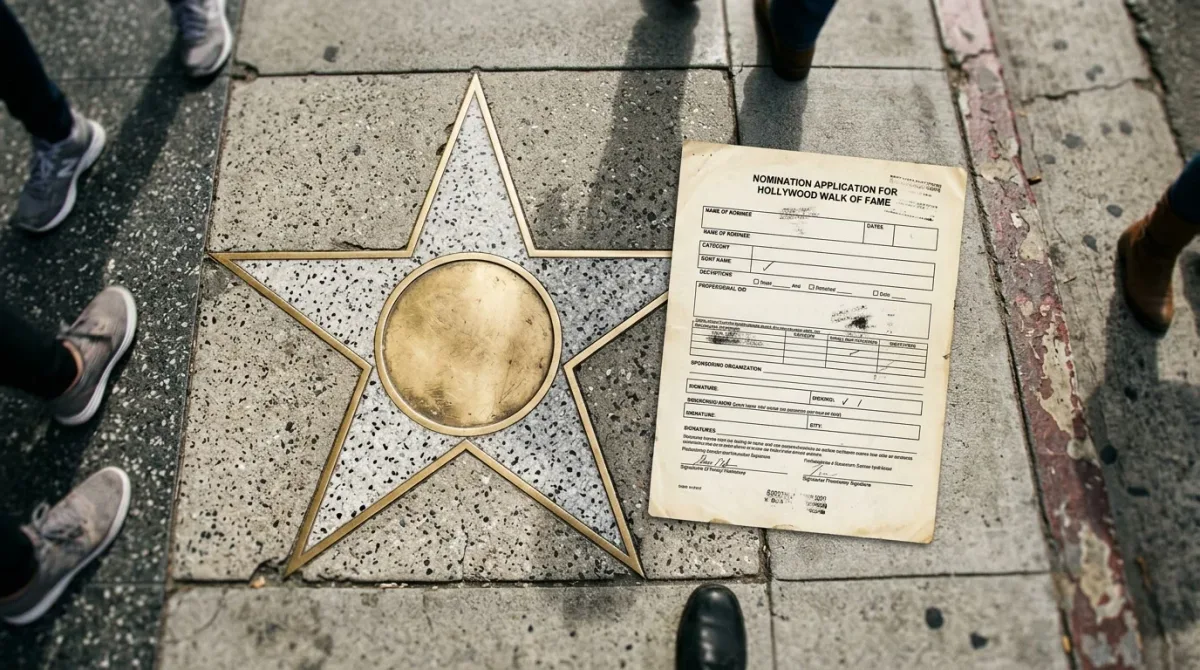
A Hollywood Walk of Fame star is not awarded, it is applied for: someone files a nomination with the Hollywood Chamber of Commerce during a spring window, pays a $275 application fee, and includes a signed letter of agreement from the honoree, per the Chamber's published nomination procedure. If the selection committee votes the name in, an $85,000 sponsorship fee comes due before the ceremony.
That two-step structure — a cheap application, an expensive installation — is the part of the process most often skipped in coverage of each year's class announcement. The Chamber, which advises the City of Los Angeles on all Walk matters, states the $85,000 covers creation and installation of the star, the inauguration ceremony, and lifetime maintenance of the Walk.
Who can nominate someone for a star?
Anyone can, provided the nominee signs off. The Chamber accepts nominations online only, and its nomination procedure page requires a letter of agreement from the nominee or their management alongside the application — meaning no one is placed on the Walk without knowing about it in advance.
The submission itself is short. The Chamber asks for a photo of the nominee, a biography of no more than 750 characters, documentation of the nominee's qualifications in their category, and a list of community contributions. The $275 application fee is charged per submission, and the Chamber states an application stays effective for two years.
Selection criteria include one condition that has nothing to do with a body of work: the guarantee that the honoree will attend the dedication ceremony if selected. A star is a live event as much as a piece of terrazzo, and the Chamber builds the promise of attendance into the paperwork.
What are the six categories, and can they change?
There are six and only six: Motion Pictures, Television, Radio, Recording, Live Theatre/Live Performance, and Sports Entertainment. The Chamber's nomination FAQ is blunt about expansion — "the categories do not change" — which is why podcasters, influencers, and video-game performers have no obvious lane unless their credits map onto an existing field.
Nominees must be active or formerly active in entertainment and must fit one of the six. The category mix also shapes the committee itself: the panel that votes on nominations is drawn from previous Walk of Fame honorees across all six fields, then-Chamber President and CEO Steve Nissen told CBS News Los Angeles when the Class of 2026 was announced in July 2025.
Live Theatre is the newest of the six and is not original to the Walk. The Chamber's own history dates its addition to 1984, twenty-four years after the first permanent star went into the sidewalk.
How does the selection vote actually work?
Stars are voted in once a year, in June, for the following calendar year's class. The Walk of Fame Committee reviews every submission at that annual meeting; the Hollywood Chamber's Board of Directors then votes to approve the slate, and the Los Angeles Board of Public Works gives final sign-off, per the Chamber's nomination procedure.
The odds are better than the mythology suggests. The Chamber's FAQ puts the committee's intake at an average of roughly 200 applications a year and the output at an average of 24 to 30 stars — a selection rate no awards body would recognize as competitive. Recent classes have run at the top of that range or above it.
The Class of 2027, announced July 23, 2026 by Walk of Famers Ming-Na Wen and Sheila E. alongside Chamber President and CEO Ron Frierson, was presented as 32 honorees selected from hundreds of nominations, with the committee chaired by Peter Roth. The Class of 2026, announced a year earlier, comprised 35 honorees, according to CBS News Los Angeles.
Class of 2027 by category
| Category | Announced entries | Examples from the Chamber's announcement |
|---|---|---|
| Recording | 10 | Karol G, Lil Wayne, Linkin Park, Waylon Jennings (posthumous) |
| Motion Pictures | 8 | Idris Elba, Kate Hudson, Sam Rockwell, Delroy Lindo |
| Television | 8 | Pedro Pascal, Lisa Kudrow, Keke Palmer, Adam Scott |
| Live Theatre/Live Performance | 3 | Jo Koy, Nicole Scherzinger, Roberto Bolle |
| Radio | 1 | Lenard "Charlamagne tha God" McKelvey |
| Sports Entertainment | 1 | Jimmie Johnson |
Some entries cover duos or groups — Cheech & Chong, Elle Fanning and Dakota Fanning, The Ramones — which is why the Chamber's headline figure of 32 honorees exceeds the number of listed line items.
What does the $85,000 pay for, and who pays it?
The sponsorship fee — the payment due once a nominee has been voted in, distinct from the $275 charged just to apply — is $85,000, and the Chamber's FAQ assigns it to the honoree after selection. It funds the star's fabrication and installation, the dedication ceremony, and ongoing upkeep of the Walk.
The fee explains a small structural feature of the ceremony calendar: recipients have two years from the date of selection to schedule their dedication before the selection expires, per the Chamber's Class of 2027 announcement. Names voted in during one June do not necessarily appear in the sidewalk the following year.
It also explains why the ceremony count in any given year does not match the class list for that year. A 2026 selection can be dedicated in 2027; a scheduled ceremony can slip. The class is a roster, not a schedule.
What are the rules for posthumous stars?
Deceased figures are eligible, with two constraints. The Chamber's FAQ specifies a two-year waiting period following a death before a nomination can be filed, states that one posthumous award may be given each year, and requires that a family member accept the star at the ceremony.
The Class of 2027 announcement named Waylon Jennings as its posthumous honoree in the Recording category. The waiting period is the reason a recently deceased performer cannot be fast-tracked into the next class, however heavy the public campaign in the weeks after a death.
How big is the Walk, and how long has this system existed?
More than 2,800 stars are set into the sidewalks of Hollywood Boulevard from Gower to La Brea and Vine Street from Sunset to Yucca, in terrazzo and brass, per the Chamber's visitor FAQ. Adjacent stars face alternating directions so pedestrians moving either way can read them.
The concept predates the pavement by years. Chamber president E.M. Stuart proposed the Walk in 1953, the basic tenets were agreed in 1955, plans went to the Los Angeles City Council in January 1956, and eight demonstration stars were unveiled on August 15, 1958, according to the Chamber's published history.
Construction began February 8, 1960; the first permanent star, for producer Stanley Kramer, was laid March 28, 1960; the Walk was dedicated November 23, 1960 with 1,558 stars in place. Los Angeles designated it Historic-Cultural Monument No. 194 in 1978, and Sophia Loren received the 2,000th star on February 1, 1994.
Sixty-six years on, the mechanism is the same one the Chamber sketched in the 1950s: a local business association, a committee of prior honorees, a city sign-off, and a fee. The glamour is downstream of the paperwork.
For a related hollywood perspective, read Ben Affleck and Matt Damon Make a Splash on Gossip Stone TV.