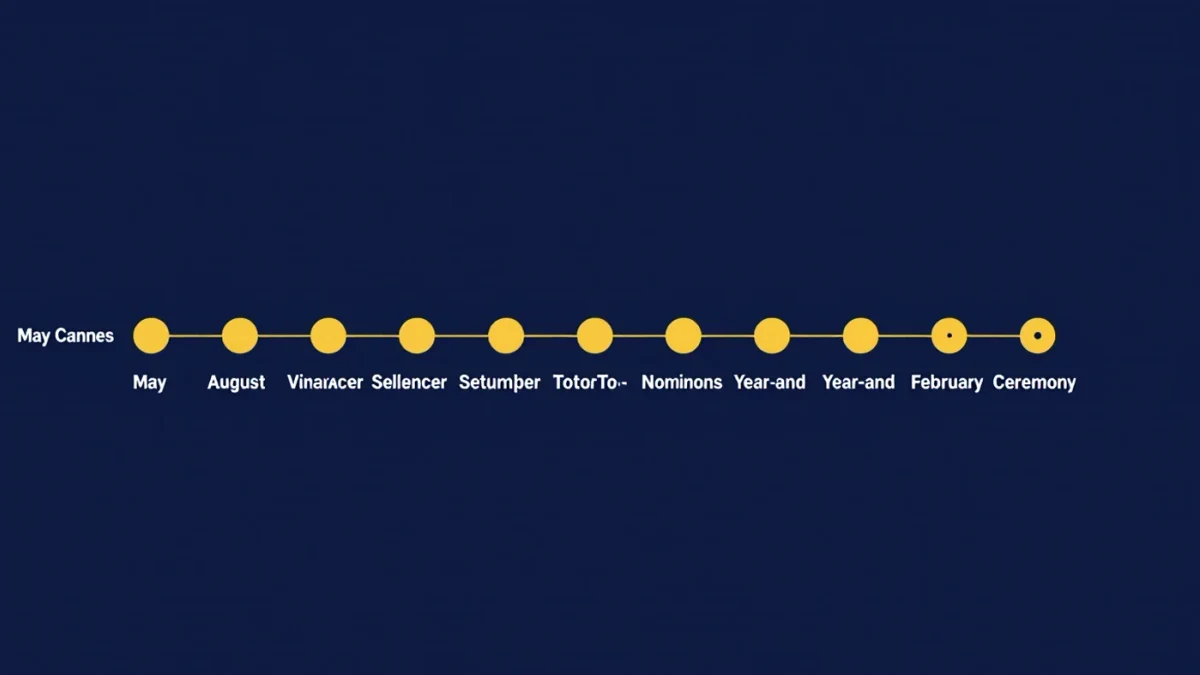
Awards season effectively begins in late summer, not winter, when three festivals in ten days, Venice, Telluride and Toronto, introduce the prestige titles that will dominate the following February's Oscars, and recent history proves the pipeline: Nomadland premiered at Venice and Toronto in 2020 and won the Best Picture Oscar, and Everything Everywhere All at Once launched at SXSW in 2022 on its way to the same award. A festival premiere is not a screening; it is the first coordinated move of a campaign, chosen for its jury, its press corps and its position on the calendar. How festival premieres launch awards campaigns is a question of sequencing, and the sequence starts months before anyone says the word Oscar.
Why those three festivals matter most
The fall trifecta works because of what each festival uniquely provides. Venice offers European prestige, a glamorous setting and a competition jury whose prizes carry awards weight. Telluride, small and unannounced until days before it happens, functions as the critics' proving ground: a film that lands there is suddenly in every serious conversation, and the festival's Labor Day timing makes it the traditional starting gun. Toronto, the largest of the three, adds something the others cannot, the People's Choice Award, voted by audiences and statistically the strongest Oscar predictor in existence, with a long run of its winners going on to Best Picture nominations and many to wins.
Cannes, in May, plays a different role. Its Palme d'Or confers prestige that campaigns convert into credibility, and winners like Parasite in 2019 demonstrated that a Cannes launch can carry a film in a foreign language all the way to a Best Picture Oscar. But Cannes sits half a year from the Academy's voting, so its awards relevance depends on a distributor's ability to keep a film alive through the summer and fall, usually by re-premiering or expanding at the later festivals.
What a premiere actually does for a campaign
The mechanics are concrete. A festival premiere generates, in one weekend, the film's first wave of reviews from the most influential critics in the English-speaking world, its first trades coverage with Oscar framing, its first audience reaction, and frequently its distribution deal: acquisition titles arrive at festivals unsold and leave with a distributor who immediately begins positioning them. A rapturous Telluride or Venice response effectively prints the campaign's first advertising quote sheet.
- Reviews: the first critical consensus forms within hours and is nearly impossible to reverse.
- Audience prizes: Toronto's People's Choice and Venice's audience award provide third-party validation campaigns cite for months.
- Sales: streamers and specialty distributors bid on finished films, and the price paid becomes its own news cycle.
- Platform launch: a festival slot often doubles as the first date of a platform release, building per-theater averages in New York and Los Angeles.
The platform release connection
Festival premieres plug directly into the platform release strategy that prestige titles use. The standard pattern premieres the film at a fall festival, opens it weeks later in a handful of top-market theaters to strong reviews and healthy per-theater averages, then expands gradually through the holiday corridor as awards nominations accumulate. Each stage feeds the next: reviews drive the opening, the opening drives nominations talk, nominations drive the expansion, and the expansion drives the revenue that pays for the campaign.
The Oscar calendar governs the whole design. Eligibility requires a qualifying theatrical run within the awards year, and nomination voting happens over the winter, so a fall premiere maximizes the time a film can be in theaters, in conversation and in voters' minds simultaneously. Premiering too early risks fading; premiering too late risks never accumulating the critical mass that nominations require.
When the strategy fails
The system punishes miscalculation visibly. A film that premieres at a major festival to tepid response has spent its one chance at a first impression, and distributors sometimes pull titles from lineups at the last minute when internal screenings suggest they are not ready, a recurring festival-week news story that itself signals trouble. Conversely, a small film that over-performs at Sundance in January, the festival that anchors the independent calendar, can find itself acquired and fast-tracked into the following awards season, though the long gap from January to voting usually demands a carefully timed re-release or streaming debut.
The festivals also concentrate power. A handful of programming teams effectively decide which prestige films get the launchpad, and a snub from all three major fall festivals leaves even a good film campaigning uphill, forced to find its audience through limited releases and critics' groups without the momentum a premiere weekend provides. That gatekeeping role is one of the least examined concentrations of influence in the film industry.
The award that funds the campaign
The final function is economic. Awards are marketing: nominations, especially Oscar nominations, measurably lift a film's box office during the voting window and its value in subsequent streaming and international deals. A festival premiere is the cheapest moment at which a campaign can win, or lose, the credibility that everything afterward is built on. That is why the fall festival lineup is scrutinized like a primary calendar, and why a single Saturday-night screening in Venice or Telluride can matter more to a film's fate than anything its distributor does for the next five months.
The second tier does the quiet work
Below the fall trifecta sits an ecosystem that shapes the rest of the awards field. Sundance in January anchors independent film, New York and London stage high-profile fall premieres with dedicated press corps, and genre festivals from Fantastic Fest to genre programs at bigger events launch the horror and genre titles that critics' groups later champion. A24, Neon and the specialty divisions build their years around this calendar, acquiring at festivals and campaigning from the moment of acquisition. A distributor's festival strategy is effectively a statement of its awards ambitions before a single ad runs, and reading the fall lineups correctly is how the trade press forecasts the season months before nominations exist.
For more context, read Award Show Ratings Trends Explained: The Long Decline And The Fixes That Worked.
For more context, read movie marketing budget.
For more context, read opening weekend numbers.