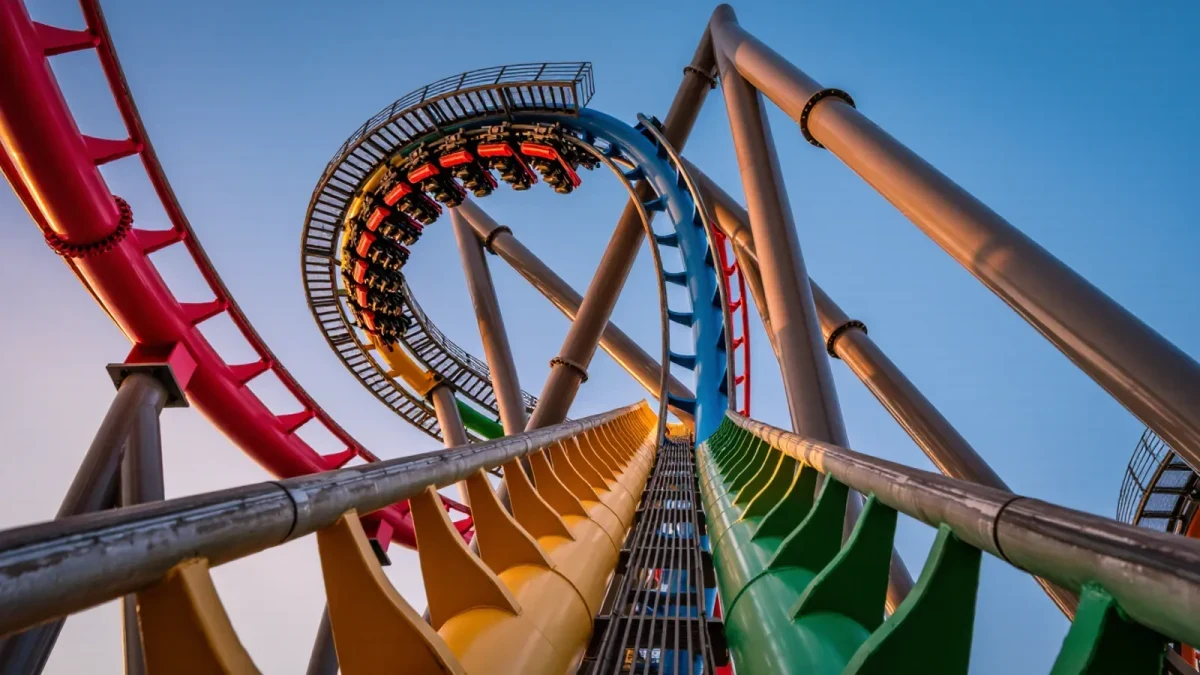
Theme park movie tie-ins are no longer marketing stunts; they are the core of the entertainment industry's capital strategy. Disney, the clearest case, announced a plan to invest roughly $60 billion in its Experiences division — parks, cruise ships and consumer products — over a decade, a commitment executives have repeated in earnings calls since it was unveiled. Universal, meanwhile, opened its Epic Universe park in Orlando in May 2025, anchored by lands built on Harry Potter, How to Train Your Dragon and classic Universal monsters. The message from both companies is that a franchise is not fully exploited until guests can walk through it.
Why do studios build rides instead of buying ads?
Because a ride compounds and an ad does not. A theatrical marketing campaign burns out in six weeks; a themed land keeps selling hotel nights, passes and merchandise for decades. Disney's Experiences segment has repeatedly posted operating margins above those of its film studio, which is why investors treat parks as the stable earnings engine and movies as the content feed that refreshes it. In earnings terms, a hit film is the loss leader and the theme park tie-in is the annuity.
The economics also run both ways. A land based on a franchise extends its cultural shelf life between film releases, keeping characters familiar to children who were born years after the last sequel. That is why studios keep building around titles with no new movie imminent — the ride itself sustains the brand.
How did the current investment cycle start?
The modern template dates to 2010, when Universal Orlando opened the Wizarding World of Harry Potter and proved that a single immersive land could transform a whole resort's attendance. Disney answered with a decade of expansion: Pandora at Animal Kingdom, Star Wars: Galaxy's Edge at Disneyland and Walt Disney World, Avengers Campus in California, and Tokyo DisneySea's Fantasy Springs, which opened in 2024 with lands for Frozen, Tangled and Peter Pan.
The competition then escalated to entire parks. Universal's Epic Universe, the first new major theme park in Orlando in more than two decades, opened on May 22, 2025, with a Harry Potter land set in 1920s Paris as its centerpiece. Disney responded by accelerating its own roadmap, including villains- and Cars-inspired projects at Magic Kingdom and a long-rumored expansion at Disneyland, all under the $60 billion umbrella.
What makes a franchise 'theme park ready'?
Executives look for three traits. First, immersive worlds: a distinct visual language guests can enter, which favors fantasy and science fiction over contemporary drama. Second, multi-generational recognition, meaning parents and children both know the property. Third, sequels or series to keep the property alive for the fifteen-to-twenty-year life of a land. Star Wars, Avatar, Harry Potter, Frozen and the Avengers fit all three criteria, which is why they dominate capital plans while Oscar winners rarely do.
Failure modes exist. Films that underperform put planned attractions in limbo, and studios have quietly shelved concepts when a franchise cooled. The safest bets are properties with decade-long track records, which explains the industry's reliance on a short list of mega-franchises.
How do tie-ins make money beyond the gate?
- Per-capita spending: themed lands reliably raise in-park spending on food and exclusive merchandise, a metric both Disney and Comcast report to investors.
- Hotels and cruises: immersive rooms and themed ships lengthen stays; Disney's cruise fleet expansion is part of the same $60 billion plan.
- Licensing: parks operated by third parties, such as Universal's Japan and Beijing resorts and Disney's Tokyo partner Oriental Land Company, return royalty streams without direct capital risk.
- Merchandise flywheel: exclusive ride-linked products drive repeat visits, and ride scenes themselves advertise retail lines.
What is the role of intellectual property versus original attractions?
IP has effectively won the argument. Classic original attractions still draw crowds, but nearly every major capital project announced since 2015 is franchise-based, and some original rides have been rethemed to IP — a practice fans criticize but operators defend with attendance data. The industry consensus, visible in both Disney's and Universal's pipelines, is that familiar worlds lower marketing costs and raise guest intent to visit.
The counter-trend is craft: operators have learned that immersion quality, not name recognition alone, determines whether a land works. Galaxy's Edge's elaborately detailed sets raised expectations for everything after it, and Epic Universe's sellout-period crowds in 2025 rewarded a park built around total environmental storytelling rather than a single marquee coaster.
How do parks and movies schedule around each other?
Increasingly, in lockstep. Ride openings are timed to film releases or streaming series launches to create combined marketing moments, and scriptwriters now sit with Imagineers during franchise planning. Sequel slates are reviewed against capital plans, because a land opening two years after a franchise's final film wastes its own marketing window.
The synchronicity also works in reverse: parks have kept franchises commercially alive during gaps between films, providing studios a reason to revive dormant properties. Hollywood greenlights have quietly started to weigh theme park potential as a factor alongside box office projections.
How much does a themed land actually cost?
Public figures are rare, but the scale is known. Galaxy's Edge was widely reported at roughly $1 billion per land, and entire new parks run into the multi-billions — Epic Universe's budget was estimated by industry analysts at more than $7 billion by the time it opened. Against that, a tentpole film's production budget of $200 million looks small, which reframes the relationship: the movie is the research and development, and the land is the product.
Those sums also explain the risk discipline. Operators stage construction in phases, tie each land to their most proven franchises first, and use attendance and per-capita spending data from early openings to greenlight later phases. Expansion is data-driven in a way film slates rarely are.
What does the next wave look like?
Disney's announced pipeline includes villains, Cars and Encanto-inspired projects in the United States alongside international expansions in Shanghai and Hong Kong. Universal has telegraphed further Orlando-area growth around Epic Universe, and regional operators such as Six Flags, post its 2024 merger with Cedar Fair, are chasing the same strategy with DC and other licensed properties. The through-line for 2026 and beyond is unchanged: studios will keep spending on movies partly because movies justify spending on parks, and the park tie-in has become the destination for franchise investment rather than the afterthought.