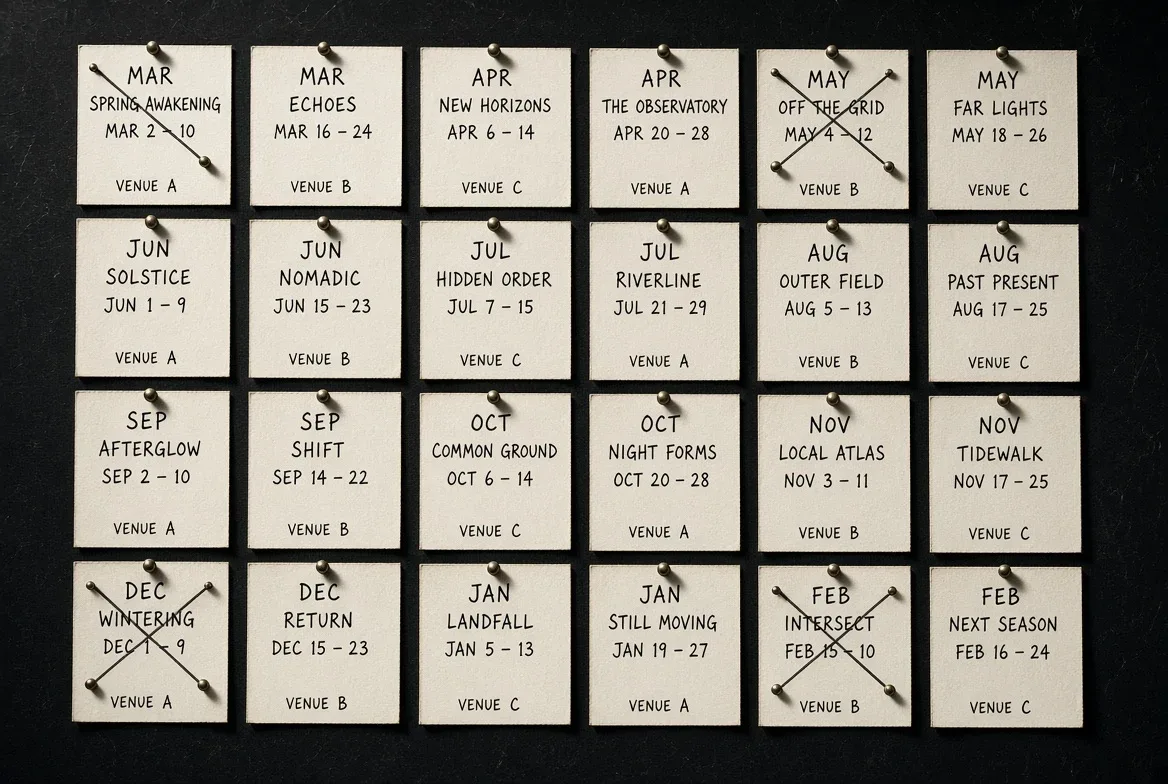
Getting a runway show onto an official fashion week schedule is not a booking. It is an application, judged by a committee. In New York the CFDA runs the list: its September 2026 Official NYFW Schedule was published on 1 July 2026 with 70 runway shows and designer presentations, and even then it went out labelled preliminary.
That word carries the whole system. A schedule stays provisional until the week opens, which is why time swaps, withdrawals and last-minute additions are a standing feature of runway news rather than an aberration. The machinery underneath is older than most of the houses moving around on it.
None of this is a velvet rope with a price on it. It is a set of published criteria, administered by three trade bodies in three cities, and the criteria are readable in full. What follows is what they actually say.
Who decides what counts as an official show?
The trade body of the city does. In New York that is the CFDA, which states that "since acquiring the Fashion Calendar in October 2014, the CFDA has served as the sole organizer of the Official NYFW Schedule." In Paris it is the Fédération de la Haute Couture et de la Mode. In London it is the British Fashion Council.
None of them own the runway. They own the list — and the list is the thing editors, buyers and production crews build their travel around. A designer can stage a show anywhere, any night, with no permission from anyone. Whether that show appears on the official calendar is a separate question with a separate process.
The CFDA opens a window and closes it. For the September 2026 season it announced that "the CFDA Fashion Calendar invites designers to apply for inclusion on the Official New York Fashion Week Schedule," with applications closing on Wednesday 20 May 2026 — nearly four months before the week itself, which ran 10 to 15 September 2026. Miss the window and the season is gone.
Where does the fashion calendar actually come from?
From a subscription newsletter started in wartime New York. Ruth Finley and the Hughes sisters published the first issue of Fashion Calendar in March 1941, according to the archive record held by the Fashion Institute of Technology — a weekly that "listed all New York and domestic fashion and creative industry events."
Its purpose was scheduling hygiene, not prestige. FIT describes it as "a service to clear dates for subscribers to avoid conflicts and maximize attendance." Two shows at the same hour split the same room of press; the calendar existed so that would stop happening. Everything that now reads as hierarchy began as traffic control.
The archive survives. The Ruth Finley Collection sits in Special Collections and College Archives at the Gladys Marcus Library at FIT, and in 2020 the college was awarded a Digitizing Hidden Collections grant to put roughly seven decades of it online. The CFDA bought the operation in October 2014. The gatekeeping function came with the filing system.
What does Paris ask for?
A committee reading. The FHCM says it coordinates Paris Fashion Week and Haute Couture Week, and that for the ready-to-wear calendars "two dedicated consultative committees" — one womenswear, one menswear — assess candidates, with panels drawn from international journalists and buyers. The stated test is not sales volume.
It is this: "the selection is based on an examination of the creative potential and international outreach of the candidate brands." The federation also rules out whole categories, stating that collections of only "accessories, swimwear, lingerie and/or bridal wear are not eligible" for the official Paris ready-to-wear calendars.
Couture is tighter still, and structurally different. Selections are made by the Chambre Syndicale de la Haute Couture Committee "once the number of open places has been determined," and the official calendar is built from members of the Chambre Syndicale plus corresponding members, guest members and guest houses chosen each season. Guest status, the federation notes, "is subject to a specific examination procedure."
The practical consequence is worth stating plainly. As Fashionista reported in its January 2026 couture schedule listing, "only official members of the Chambre Syndicale de la Haute Couture — Chanel, Dior and the like — are guaranteed a spot on the schedule," with the remaining slots handed to corresponding and guest members season by season. Everyone else is re-auditioned twice a year.
What does London ask for?
Proof of trading, and a creative case. The British Fashion Council curates the London Fashion Week schedule and states that main-schedule applicants "will be assessed on creative merit," with eligibility requiring a designer to be "over one year in business" and showing collections that are "ready-to-wear or accessories, not bridalwear or childrenswear."
One barrier has come down. The BFC's published criteria confirm the requirement "no longer includes minimum wholesale stockist requirement" — removing the demand that a young label already hold a book of stockists before it can be listed. Every designer must reapply each season regardless of how many times they have shown.
Money enters at the listing stage rather than the judging stage. Physical main-schedule activations — the BFC's own term covers "appointments, screenings, pop-ups and exhibitions" alongside catwalks and presentations — are subject to listing fees, waived for active BFC members. There are also routes designed for the newest labels: Digital DiscoveryLAB is open to brands "under three years in business," capped at two participations, and digital entries must contain "an element of moving content, a lookbook/imagery will not suffice."
The routes are granular, and the deadlines are staggered. At the time of writing, the BFC's application page listed most September categories as closed, with physical evening events — anything "taking place from 7pm onward" — still open until 24 August 2026 and judged on the merit of the event itself.
What does "preliminary" actually mean?
That the list is not finished. The CFDA released the September 2026 schedule on 1 July 2026 — ten weeks before the first show — as a preliminary document running from Henry Zankov's debut as artistic director for Diane von Furstenberg on Thursday 10 September to Thom Browne on Tuesday 15 September.
Ten weeks is a long time in a business where a collection can be delayed, a venue can fall through and a creative director can change house. Slots move. Names drop off and reappear. The schedule that circulates in July is a forecast; the one that matters is the one standing on the morning of the show.
This is the original function surfacing again. FIT's account of the Fashion Calendar describes it as a service to clear dates and avoid conflicts — a document whose whole value lies in being amended the moment reality shifts. A calendar that never changed would mean nobody was using it.
Application windows, by contrast, do not move. New York's closed in May for a September week; London's ran through the summer on staggered category deadlines. The list is fluid. The door into it is not.
Why do so many alternative labels stay off the official calendar?
Read the criteria back and the pattern explains itself. A label must have been trading over a year in London. It must not be bridal-only or accessory-only in Paris. It must reapply every season, absorb listing fees where they apply, and satisfy a committee of journalists and buyers assessing "international outreach."
Much of the alternative wardrobe fails those filters on structure alone, not on quality. Corsetry ateliers, made-to-order houses, latex studios and jewellery-led practices are exactly the shapes that category rules and trading-history rules were never written to accommodate. Nothing in any of these documents stops such a label from staging a show. It only stops the show appearing on a particular list.
That is the distinction worth carrying. Official and unofficial are administrative categories, not aesthetic verdicts — the CFDA's own schedule for September 2026 arrived as a preliminary document and changed, because the calendar has always been a working file rather than a canon. Ruth Finley built it to stop two designers booking the same Tuesday afternoon. The rest was added later.
For more context, read Who actually decides when fashion week happens.
For more context, read Why black became the default color of the avant-garde runway.
For more context, read Demna to Gucci — what it means for the dark end of fashion.