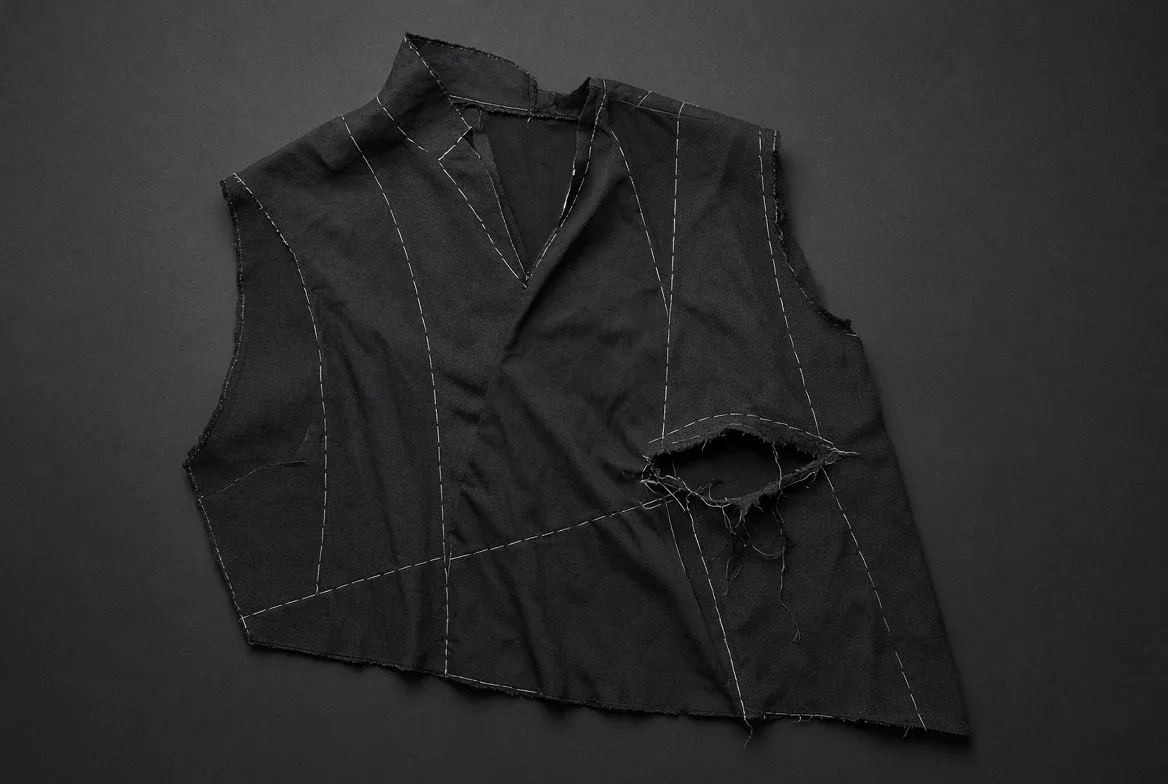
The rule that avant-garde and goth-adjacent runways run in black wasn't a style choice that accumulated by accident — it traces to one Paris showing. In 1981, Rei Kawakubo brought her label Comme des Garçons to the French capital for the first time, and critics met her monochrome, deliberately frayed collection with open hostility, coining the terms "post-atomic" and "Hiroshima chic" to dismiss it, per TIME's retrospective on Kawakubo. Black is now the default palette for serious tailoring; in 1981, per the same account, "black was not a color worn during the day."
What actually happened in Paris in 1981?
Kawakubo showed a ready-to-wear collection built from an inky, near-total black palette, asymmetrical cuts and distressed fabric — coats with unfinished seams, sweaters with deliberate holes — to a Paris press corps unaccustomed to seeing any of it treated as intentional. The reaction was not polite skepticism; TIME describes critics branding the work "post-atomic" and "Hiroshima chic," language that read the designs as a kind of ruin rather than a proposal. The Victoria and Albert Museum's own collection notes are blunter about the scale of it, describing the debut as having "created a storm of controversy for its predominate use of black and distressed garment surfaces." That controversy is the hinge point: before it, black-as-daywear barely existed as a runway idea; after it, an entire design vocabulary had a starting reference.
Where did the "distressed" look actually come from?
Kawakubo's process, not just her color choice, is what made the 1981 collection legible as a system rather than a stunt. The V&A notes she "has no formal training as a tailor, relying on the ability of pattern-makers to interpret her austere design concepts" — meaning the tears, holes and frayed edges that recurred through the decade weren't damage applied to finished garments but instructions built into how the garments were cut in the first place. That distinction matters to how the look reads on a runway: a hem that fails by accident looks like an error, but a hem cut to fail on purpose, repeated consistently across a collection, reads as a stated position. The Metropolitan Museum of Art's collection record on a Comme des Garçons fall/winter 1982-83 ensemble describes the house, in the seasons right after the Paris debut, working in "a consistent black palette, outsized silhouettes, and asymmetry," adding that the designs kept eliciting "extreme reactions from critics owing to their repudiation of the fashionable ideals of the period." The Met also records the philosophy behind it: after 1979, per the museum, Kawakubo decided to "start from zero," building clothes with no prior fashion reference point rather than revising an existing silhouette — a working method, not just a color story, which is why the vocabulary outlasted the initial press cycle.
What evidence of this survives in museum collections?
The garments that document this shift aren't rare archival fragments — several sit in permanent museum collections precisely because curators treat the 1981 debut as a turning point worth preserving material evidence of. The V&A holds a pair of Comme des Garçons men's shoes, black corduroy with grey-and-yellow striped platform soles, dated to roughly 1995, cataloged with the note that the house's aesthetic that decade and after remained rooted in the 1981 controversy over "predominate use of black and distressed garment surfaces." The Met's fall/winter 1982-83 ensemble record serves the same function from the other side of the Atlantic, fixing a specific, dated garment to the same design language rather than leaving the story as anecdote. Between the two institutions, the throughline is consistent: black, asymmetry, visible construction, repeated and dated across more than a decade of acquisitions, not a single controversial season that faded.
Why did the backlash turn into a standard?
The shift from scandal to convention took the rest of the decade, not a single season. The V&A's collection notes describe Comme des Garçons garments through the 1980s as "frequently monochromatic, asymmetrical and draped over the body, often featuring tears, holes and frayed edges" — meaning the 1981 palette wasn't a one-off provocation but a sustained house grammar that other designers, and eventually other subcultures, had time to absorb. TIME's account is direct about the long arc: "black is now the preferred palette for day," a reversal of the pre-1981 convention the same piece describes. That reversal is also the point where this history runs alongside goth and other black-clad subcultures that were forming their own uniform around the same period — not because one caused the other, the sources make no such claim, but because both were treating unfinished black tailoring as a serious visual language rather than mourning wear or workwear, at roughly the same historical moment.
Does this still shape what avant-garde runways do now?
The specific grammar Kawakubo's 1981 collection introduced — desaturated palette, asymmetry, visible construction, deliberate imperfection — is still the baseline vocabulary avant-garde and alternative-adjacent runway design draws on when it wants to signal seriousness rather than costume. The Met frames Kawakubo's ongoing relevance in exactly those terms, noting she "has consistently defined and redefined the aesthetics of our time" and that her work "upends conventional notions of beauty." None of the three institutions cited here frame that influence as settled fashion trivia; each treats it as a working reference point, which is the same way it tends to surface on runways that owe it a debt without naming it outright. For coverage of shows that build on that lineage today, without an official calendar's gatekeeping, that's the territory this category exists to track.
FAQ
- Was Comme des Garçons a goth label? No — Kawakubo's house has never been positioned as goth or subcultural. The overlap is aesthetic and historical: both drew on black, asymmetry and visible deconstruction as a serious design language around the same period, per the V&A and Met collection records cited above.
- Did critics only object to the color? No. TIME's account and the V&A's collection notes both describe the backlash as targeting the combination of an all-black palette with distressed, unfinished construction — the fabric treatment was as central to the controversy as the color.
- When did black become standard rather than shocking? The sources don't give a single date; TIME's retrospective frames it as a gradual reversal over the years following 1981, by which point, per that account, black had become "the preferred palette for day."
For a related history perspective, read Where goth fashion's black uniform actually comes from.
For more context, read Demna to Gucci — what it means for the dark end of fashion.
For more context, read How a label actually gets onto the official runway calendar.
For more context, read Who actually decides when fashion week happens.