Box office reporting begins with a deceptively simple act: on Sunday morning, each distributor estimates how much its own films earned, and the measurement firm Comscore aggregates those numbers into the weekend chart the entire industry treats as scoreboard. The figure splashed across headlines is not a count of tickets sold or a precise audit of cash in drawers. It is a studio-generated projection of gross receipts for Friday through Sunday, corrected on Monday afternoon when the actuals land. Understanding how box office reporting works means understanding who counts the money, what is being counted, and why a chart that looks authoritative is really a negotiated consensus between studios and exhibitors.
Who actually counts the money?
Comscore is the industry's box office processor in North America, collecting grosses from virtually every theater in the U.S. and Canada, a market of roughly 40,000 screens across thousands of locations. Theaters report their ticket revenue through point-of-sale systems and central reporting chains. Studios reconcile those reports against their own booking data, because the distributor, not the theater, is the party that reports weekend figures to the press. Comscore's role is aggregation and standardization: it turns thousands of individual theater reports into a single comparable dataset.
The result covers the combined U.S.-Canada market, which the trade press treats as one territory labeled 'domestic.' There is no separate American chart. A film's domestic gross is, by definition, the gross from both countries, and it is reported in U.S. dollars regardless of where the tickets were bought.
What exactly is a weekend?
The standard reporting window runs Friday through Sunday. But the Friday gross almost always includes Thursday previews, evening shows that typically begin at 5 p.m. or 7 p.m. the night before official release. Those previews are folded into Friday's number, which is why a film can post a massive 'opening day' that technically began 24 hours earlier.
Holiday weekends complicate the arithmetic. A Thanksgiving release is measured over both a three-day and a five-day window, and Memorial Day or Labor Day titles get three-day and four-day figures reported side by side. Trade outlets specify which window they are using because the difference can be tens of millions of dollars on a tentpole.
Why are Sunday numbers estimates?
Theaters do not close their books on Saturday night. Sunday showtimes are still selling tickets while the weekend chart is being written, so distributors project Sunday attendance using models built from comparable films, historical Sunday drops, and advance-sales data. A family film might hold better on Sunday than a horror title, and the projections account for that.
Monday's actuals rarely move a total by more than a percent or two, but on a close race they can reorder the chart. Finishing first or second on Sunday, then losing the position when actuals arrive, is a routine Monday story in trade coverage. By Tuesday the estimate-based narrative is already fixed, which is one reason studios care so much about the Sunday number itself.
Gross versus rentals: what the studio keeps
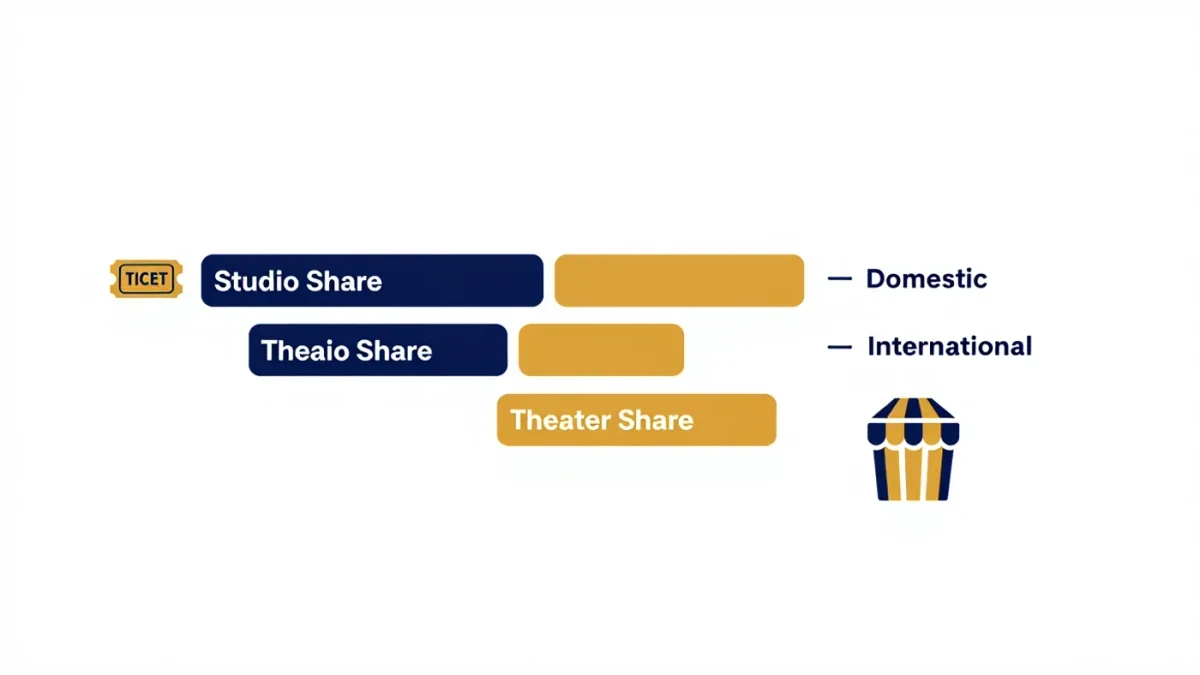
The reported box office is the gross, the full ticket price paid by consumers. The studio does not keep all of it. Distributors receive rentals, their share of the gross, negotiated with exhibitors through film-by-film terms that typically slide over the course of a run.
| Revenue stage | Approximate distributor share | Notes |
|---|---|---|
| Domestic theatrical (opening weeks) | Roughly 50-60% | Split favors the studio early, then shifts toward the theater |
| Domestic theatrical (late run) | Roughly 35-45% | Long-running films increasingly favor exhibitors |
| International theatrical | Roughly 40% or less | Lower average share, varies by market and deal |
A commonly used industry shorthand holds that a studio needs to gross roughly twice its production budget worldwide, before marketing costs, to break even in theatrical alone. The math is rough, but it explains why a $200 million film 'opening' to lukewarm numbers is a bigger problem than the headline gross suggests.
What is excluded from the chart?
Several revenue streams never touch the weekend box office. Premium pricing for large formats and motion seats is included, but concessions, the highest-margin part of a theater's business, are not, because they belong entirely to the exhibitor. Merchandise, soundtrack sales, licensing and eventual streaming payouts sit outside theatrical reporting entirely.
The chart also only measures what is reported. Special event screenings, some film-festival showings and one-off re-releases may appear or not appear depending on how they were booked and reported. When a distribution model blurs the line, as with films that get token theatrical runs before streaming, the reported gross can be small enough that it tells you almost nothing about the film's real economics.
Inflation, records and the fine print
Record headlines deserve skepticism. A nominal-dollar record says nothing about admissions, and ticket-price inflation, plus the growth of premium-format surcharges, means the biggest-grossing films are not necessarily the best-attended films. Adjusted-for-inflation charts, which organizations and researchers compile from admissions and average-price data, tell a different story that the industry's promotional machinery has little incentive to emphasize.
Similarly, global cumulative records arrive with asterisks: earlier films earned their totals when there were fewer screens, fewer premium formats and smaller international markets. None of this makes the weekend chart useless. It remains the fastest, most comparable signal the industry has. But it is a signal produced by the studios whose films it ranks, revised a day later, and denominated in gross revenue that the studios only partly keep. Reading it well means keeping all of that in view every Sunday.
Where the numbers get published
The weekend chart reaches the public through a short pipeline. Comscore's aggregated data goes to studio distribution heads on Sunday morning, the trades, Variety, Deadline, The Hollywood Reporter and TheWrap, publish the chart the same day from that feed, and aggregator databases such as Box Office Mojo and The Numbers maintain the cumulative historical record that longer-range analysis depends on. Each layer adds interpretation, and the interpretations occasionally diverge: which window is being cited, whether previews are separated, whether a milestone is nominal or adjusted.
That is why two outlets can report the same weekend with slightly different figures on the same afternoon. One is citing the Sunday estimate for a three-day window, another the four-day holiday figure, a third the Monday actual. None of them is wrong. The discipline for readers is checking which window and which vintage of the number a headline is using, a habit that resolves most apparent contradictions in box office coverage before they start.