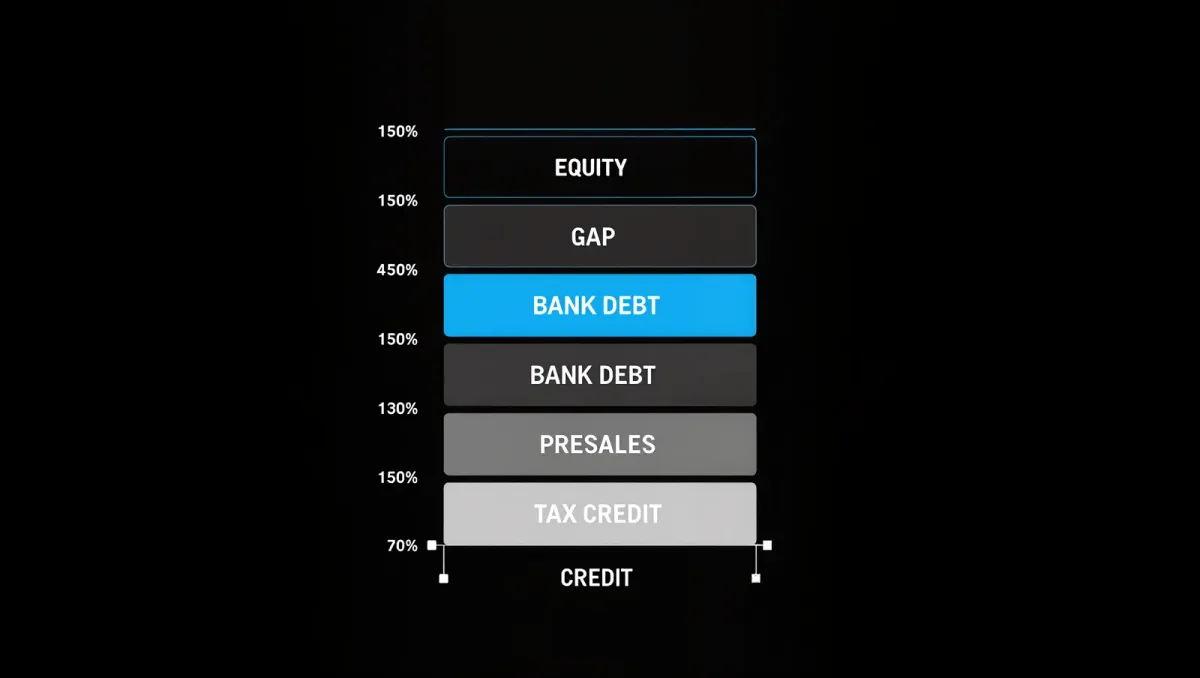
Film tax incentives decide where movies shoot by discounting 20 to 40 percent of qualifying spend, and the arithmetic now precedes creative geography in virtually every location decision. Georgia's production income tax credit of 30 percent on qualifying in-state expenditures — the program that built Atlanta into a production hub rivaling Los Angeles — and the UK's Audio-Visual Expenditure Credit, worth roughly 25 percent net on qualifying costs, are the two anchors of the global system. A $100 million production that qualifies for a 30 percent credit recovers $30 million against its tax liability or, in jurisdictions that allow transferable or refundable credits, sells that value for cash. At greenlight, that difference is a line item that can exceed the entire above-the-line budget.
How do the credit structures differ?
There are three broad mechanisms. Refundable and transferable credits, used in Georgia and most U.S. states, function as near-cash: a production without state tax liability can sell the credit to a Georgia taxpayer at a slight discount or receive a refund. Rebate programs, common in Canada and several U.S. states, pay cash directly on qualifying labor and spend, often at differentiated rates — a base rate with bonuses for local hiring, regional shooting or diversity targets. Tax-expenditure systems like the UK's are structured as credits against corporate tax on production profits, with the practical effect of a guaranteed minimum benefit regardless of the film's ultimate profitability. The differences matter because they determine certainty: a refundable credit is bankable at greenlight, while a credit contingent on profit is not.
Qualifying rules shape behavior just as much as rates. Most programs require minimum in-state spend, exclude above-the-line salaries above certain thresholds or cap resident-versus-non-resident labor credits, and mandate that the production register and pass audit. Those rules are why credits influence crew hiring, stage construction and vendor procurement — the entire local production ecosystem — rather than merely writing a check after the fact.
Why did production cluster where it did?
Because incentives compound. A jurisdiction that sustains a credit for a decade accumulates crew depth, stage infrastructure, equipment houses and post-production vendors, which lowers the practical cost of shooting there beyond the credit itself. Georgia's credit, enacted in 2008 and expanded repeatedly, generated multibillion-dollar annual production spending by the 2010s and a self-sustaining cluster: crews no longer travel in from Los Angeles, because they live there. The UK built the world's premier stage infrastructure — the Pinewood, Leavesden and expanding regional studio complexes — on the same compounding logic, combined with English-language crews and time-zone compatibility with Los Angeles. Canada, Australia, New Mexico, New York and Louisiana each run versions of the same flywheel.
The clustering has a consequence for the places without credits. California's own program, introduced in 2015 to counter runaway production, is capped and competitive rather than open-ended, which is why the state retains creative and executive functions while substantial photography migrates. Los Angeles remains the industry's headquarters; it is no longer its factory floor.
How do incentives enter the greenlight process?
Early, formally and numerically. Studio greenlight packages include incentive modeling alongside budget, casting and release plan: a production designed to shoot in the UK versus Georgia versus Ontario presents different net costs, and the deltas between jurisdictions on a $150 million film reach tens of millions of dollars. Scripts get written with production geography in mind — a story set anywhere can be shot anywhere, so contemporary thrillers and ensemble dramas are location-flexible in a way period-specific New York stories are not. When a film requires an identifiable location, the incentive question collapses; when it does not, the incentive frequently decides.
Stacking is the other greenlight mechanic. Co-production treaties and jurisdictional combinations let productions layer a federal credit, a provincial or state credit and municipal rebates. A production structured across Ontario's provincial and federal Canadian programs, or a UK shoot using the expenditure credit plus regional funds, recovers value that no single program offers. International co-production treaties add treaty-country access to national funding bodies and broadcast quotas — a financing architecture that shapes independent cinema even more than studio slate.
What are the criticisms?
The economic debate is real. Studies of state programs, including academic analyses of individual credits' fiscal returns, repeatedly find that many jurisdictions pay out more in credits than they recover in net economic activity and tax revenue — the programs are defended as industry policy and economic development rather than revenue generation. There is also a race-to-the-bottom dynamic: jurisdictions bid rates upward, and when a cap or sunset clause is introduced, production leaves quickly, as several U.S. states learned after trimming or letting programs lapse. The labor critique is structural: incentive-built production hubs employ local crews, but the above-the-line economics and profits remain concentrated in Los Angeles.
Studios, for their part, treat the system as weather — a given to be optimized, not evaluated. The practical upshot is that the geography of film production is now set primarily by legislatures rather than locations. When a state raises its credit, its soundstage bookings rise within two production cycles; when one lapses, they fall just as fast. The map of where movies are made is redrawn, session by session, in statehouses and parliaments.
How do incentives affect below-the-line jobs?
The labor market is where incentives bite hardest. A jurisdiction with a sustained credit develops a resident crew base — camera, grip, electric, art department, costume — trained on incoming productions and paid at rates competitive with Los Angeles once the credit subsidizes the employer's cost. When a program lapses or caps, that workforce idles or relocates, and rebuilding it takes years, longer than it took to lose it. This is why incentive policy is fought over as jobs legislation rather than tax policy: the credits are effectively industrial policy for a portable, high-wage, low-footprint manufacturing sector. Crew-members' unions track the programs' legislative status the way farmers track weather, because a single committee vote in a state capitol determines whether next year has work in it.
The effect also stratifies labor geographically. Above-the-line talent travels to wherever the production lands; below-the-line employment follows the incentive map. A gaffer's career is built in Atlanta, Toronto, Albuquerque or London rather than on one studio lot, and the training pipelines — state-funded film workforce programs attached to the credits — have become a standard component of incentive legislation precisely because local hiring requirements and labor multipliers are how the programs justify their fiscal cost.
What should productions watch when comparing jurisdictions?
Four variables dominate the comparison. The effective net rate, after discounts for transferring or brokering credits, not the headline rate. Certainty: whether the program is statutory and open-ended, capped and competitive, or subject to sunset, and how the certification and audit process treats timing. Qualifying-spend rules: what portion of above-the-line, travel and post-production counts, since a credit on a narrow base can be worth less than a smaller credit on a broad one. And infrastructure depth: whether the jurisdiction can actually crew and stage the production at the required scale, because a credit cannot compensate for missing infrastructure on a nine-figure shoot. The sophisticated production compares net, not nominal, value — and the sophisticated legislator designs programs around exactly that calculation, knowing the studios are doing the same math on the other side of the table.