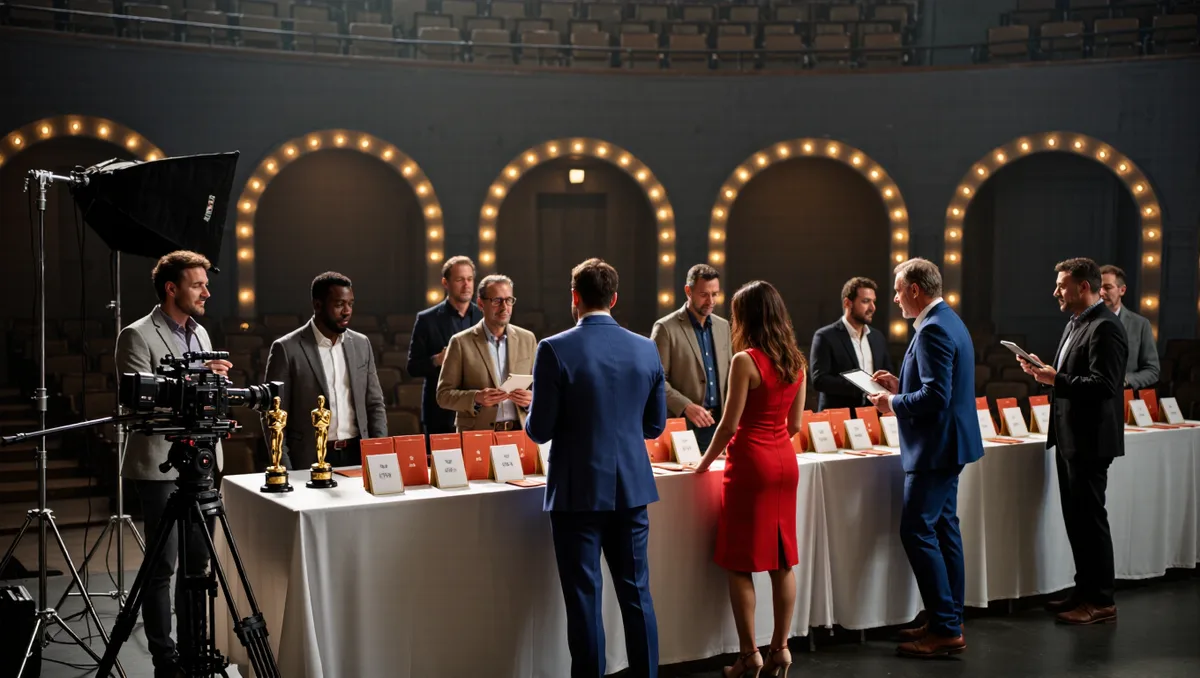
Awards ceremony music exists for one reason above all: time control. The fanfare that opens the show, the short walk-up sting under each winner's name, and the orchestral play-off that swells under a long thank-you speech are all built to move a live broadcast along. The music you hear is less a concert than a scheduling tool with a brass section.
The format it serves is old. According to Wikipedia's overview of the Academy Awards, the first ceremony ran about 15 minutes for an audience of roughly 270 people at the Hollywood Roosevelt Hotel in 1929, and the show has since grown into a televised event running for hours. Music is how a production keeps that growth from becoming chaos.
Awards shows share a musical grammar, and once you know its parts, you can hear the whole machine working. This piece breaks that grammar down: what each cue is for, who writes it, and why the play-off is the most misunderstood sound on television.
What is the walk-up sting, and why is it so short?
The walk-up sting is the short musical phrase that plays as a winner rises from their seat and heads to the stage. It is deliberately brief, usually a few seconds of bright orchestral writing, because its job is to fill dead air, not to perform. An empty stage is awkward on camera; a rising string line turns that pause into momentum.
The sting also does emotional work. A major-key fanfare tells the home audience this is a peak moment, even if the winner is a sound editor nobody in the living room has heard of. Television music has always carried that burden: it signals importance that the picture alone cannot. The same logic applies whether the show is film, television, music or theatre; the counterpart ceremonies modeled on the Oscars, as the Academy's own history notes, borrowed the whole format, music included.
Practically, the sting is timed to the walk. Music directors rehearse it against the longest walk from the deepest seat, because a cue that ends before the winner reaches the microphone leaves silence on air. That is why the phrase often has a flexible tail, an unresolved chord the conductor can hold until the winner arrives.
Why does the play-off music start so early?
The play-off is the swelling orchestra that rises under a winner's speech, and winners routinely read it as an insult. It is not. It is a countdown. A live broadcast is a stack of hard timings: ad breaks, satellite windows, a fixed end. When a speech runs long, the music director starts the cue softly and builds, giving the speaker a warning that gets louder by the minute.
The cue is usually written to be emotionally warm rather than harsh, which is why it confuses people. An upbeat, celebratory theme under your own voice sounds like a tribute while it is actually telling you to wrap. Some winners talk over it; a few stop and let it play, which reads on television as grace under a producer's thumb.
Our analysis: the play-off is the clearest example of the trade-off at the heart of every trophy show. The production buys certainty, the winner buys a moment, and the orchestra arbitrates. The music is never the villain. The schedule is.
Who writes this music, and how is it performed?
Each show commissions its own musical director, who arranges the walk-up stingers, the play-off cue and the segment music, often adapting a recognizable orchestral palette for that year. The material is performed live by a house orchestra, usually offstage or in a side studio, conducted in real time against the broadcast. That is why the timing feels human rather than mechanical: a conductor is watching monitors and following winners, not a click track.
The live requirement shapes the sound. Orchestral writing cuts through a noisy hall, reads instantly on a TV mix, and can stretch or shorten at the conductor's will. A pop track cannot pause mid-bar while a winner hugs three people. This is also why the sound of ceremony music barely changes decade to decade: the constraints select the style, not fashion.
Readers who want the wider sonic context can see how cinema sound itself has been rebuilt in the modern era in Dolby Atmos Explained: How Object-Based Sound Rebuilt the Cinema Soundscape. The broadcast hall is a different acoustic problem, but the same principle applies: the mix is engineered for a listening position, and on trophy night that position is your couch. For related coverage, see Dolby Atmos Explained: How Object-Based Sound Rebuilt the Cinema Soundscape.
How has the ceremony's structure shaped its music?
The modern show's shape comes from decades of broadcast evolution. Per the Academy Awards history on Wikipedia, the second ceremony in 1930 was the first broadcast on radio, television arrived in 1953, and since 1973 every ceremony except 2021 has ended with Best Picture, the slot the whole musical arc builds toward. Each of those changes tightened the timing the music has to serve.
Even presentation formats move the music around. Wikipedia records the introduction of the five-presenter format for acting categories in 2009, revived in 2024 after a 15-year hiatus, in which five previous winners each introduce one nominee. More introductions mean more transitions, and more transitions mean more stingers, segues and play-off decisions for the music team.
The envelope ritual has its own sound logic. The sealed-envelope procedure the Academy adopted in 1941, after a newspaper printed winners early, created the dramatic pause before the reveal, and the sting that lands on the winner's name is timed to that pause. The pause is theater; the music is the punctuation.
What this means for how you hear the show
Practical steps for a sharper ear:
- Listen for the unresolved tail on a walk-up sting. If it holds a beat too long, the conductor is stretching for a slow walker.
- Time the play-off. It usually enters softly well before it becomes audible, then builds in steps. You are hearing a producer's patience running out in real time.
- Note the final-cascade music under Best Picture. Because the show ends there, the closing cue is written to run long and absorb an extended speech and a stage full of people.
The broader context matters too. Trophy shows have spent years fighting audience decline and format fatigue, a story tracked in Award Show Ratings Trends Explained: The Long Decline And The Fixes That Worked, and Wikipedia notes the Oscars will move to YouTube in 2029 after years of falling network ratings. A streaming stage may change the cameras and the runtime, but the scheduling problem stays, so expect the stingers and play-offs to survive the platform shift. The season's wider mechanics, from campaigns to voting, are covered in How Awards Season Really Works: From Screeners to Statuettes.
The verdict is simple. Ceremony music sounds the way it does because it is doing a job nobody applauds: turning an unpredictable room full of emotional people into a broadcast that ends on time. Hear it that way, and the play-off stops being rude. It becomes the most honest moment of the night.