Hollywood Arts is not a real school. It is the fictional performing-arts high school at the center of the Nickelodeon sitcom Victorious, where students study acting, music, and stagecraft between lockers and coffee runs. The name keeps drawing searches because the show built a specific, believable world around it, and fans still want to know where that world came from.
The short answer: the school exists on soundstages and sets, not at a street address. But the setting borrows its identity from the real neighborhood it is named after, a place whose film-industry history explains why a fictional arts academy feels plausible at all.
What is Hollywood Arts on screen?
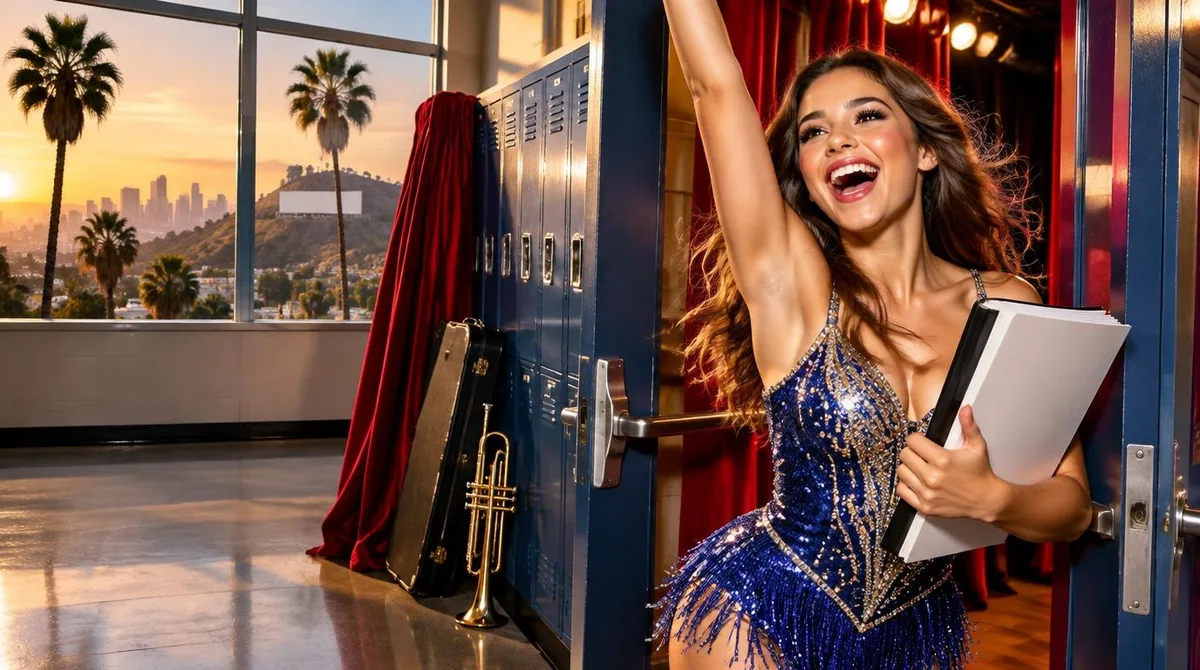
In the series, Hollywood Arts works like a specialized high school for the performing arts. Students train in acting, singing, and technical theater, and the show's plots lean on that structure. A school built around performance gives every episode a built-in stage, a built-in audience, and a reason for characters to rehearse, audition, and compete.
That design choice matters more than it looks. A setting with performance baked in lets a comedy deliver a musical number or a stage disaster without bending the premise. It also gives the school itself a personality: the weird teachers, the showcase culture, the sense that everyone is auditioning for something. The building becomes a character, which is part of why viewers remember it after the show ends.
Where is Hollywood Arts supposed to be?
The show never pins the school to a real address, and that is standard practice for a sitcom. Interiors are shot on studio sets, and exterior establishing shots are kept generic or reused, so the campus reads as "somewhere in Los Angeles" rather than a mappable location. Fans who hunt for the school end up hunting for studio backlots, and those rarely announce themselves.
The name, though, points at a real place with a real history. According to Wikipedia, Hollywood is a neighborhood in Central Los Angeles whose name became synonymous with the American film industry, and major studios such as Universal Pictures, Walt Disney Studios, and Sony Pictures operate in or near it. That context makes a fictional film-adjacent high school in Hollywood feel almost inevitable.
The industry did not always sit there. As HISTORY recounts, filmmakers moved west in part because they could not easily be sued in California for infringing on motion-picture patents held by Thomas Edison's company, and because warm weather and varied terrain made shooting practical year-round. A neighborhood built by patent-dodging and sunshine is exactly the kind of place that would later inspire a comedy about kids chasing showbiz careers.
Why does a fictional school still pull searches?
Three forces keep the name alive. First, streaming: when a completed series lands on a streaming service, a new audience finds it years after broadcast, and that audience asks the same questions the first one did. Where was it filmed? Is the school real? Can you visit? We covered a connected angle in Streaming Video Quality Explained: Why the Same Film Looks Different Everywhere.
Second, the setting is aspirational. A performing-arts high school is a fantasy of a school where the thing you love is the curriculum. Viewers who wanted that school search for it the way they might search for any fictional place that felt real, from a TV diner to a small-town main street.
Third, fandom does its own location work. Fan communities catalog filming spots, compare set details across episodes, and trade theories about where the campus would sit if it existed. That activity generates exactly the search phrases a curious newcomer types in, which keeps the fictional name circulating long after production wrapped.
The real Hollywood behind the name
The real neighborhood earned its myth the slow way. Wikipedia's entry traces Hollywood from its incorporation as a municipality in 1903 through its consolidation with Los Angeles in 1910, after which large portions of the film industry migrated to the area. HISTORY notes that by 1911 the first movie studio had appeared on Sunset Boulevard, and that by the 1930s the movie industry ranked among the largest businesses in the United States.
Even the famous sign started as advertising. HISTORY reports that the sign was erected in 1923 as a real-estate billboard reading "Hollywoodland," paid for at a cost of $21,000, and was only trimmed to its current form after decades of decay and partial restoration. A neighborhood that literally began as a promotional sign is a fitting namesake for a fictional school that is itself a kind of advertisement for the dream of being discovered.
That is the quiet joke underneath the setting. Hollywood Arts sells the same product the neighborhood has sold for a century: the idea that talent plus proximity equals a career. The sitcom just moved the pitch to teenagers.
What this means for viewers and fans
Our analysis: treat Hollywood Arts the way you would treat any fictional geography. It is a composite, built from set design, a borrowed place name, and audience imagination. Searching for its real-world counterpart will lead you to Los Angeles studio history, not to a campus gate, and that history is worth the detour.
Practical steps for the curious: watch how the show uses its performance spaces, then look at how real Los Angeles production works, from soundstage shooting to backlot exteriors. Readers who want the wider context on how the industry reports and sells its work can start with our explainer on How Box Office Reporting Actually Works: Estimates, Actuals and the Trackers Behind the Numbers, or browse the rest of our screen coverage. The gap between a fictional school and a working industry town is also a good lens on celebrity culture itself: the fantasy and the business share a zip code, and always have. For related coverage, see How Box Office Reporting Actually Works: Estimates, Actuals and the Trackers Behind the Numbers.
The evidence establishes a clear picture. Hollywood Arts endures because it fuses a relatable school story with a real place whose name still carries the weight of the film industry. What remains unknown is the mundane stuff fans most want: exact soundstage addresses and set locations, which the show's production never made a public map of. Until someone with the paperwork says otherwise, the school stays where it has always been, on the stages.