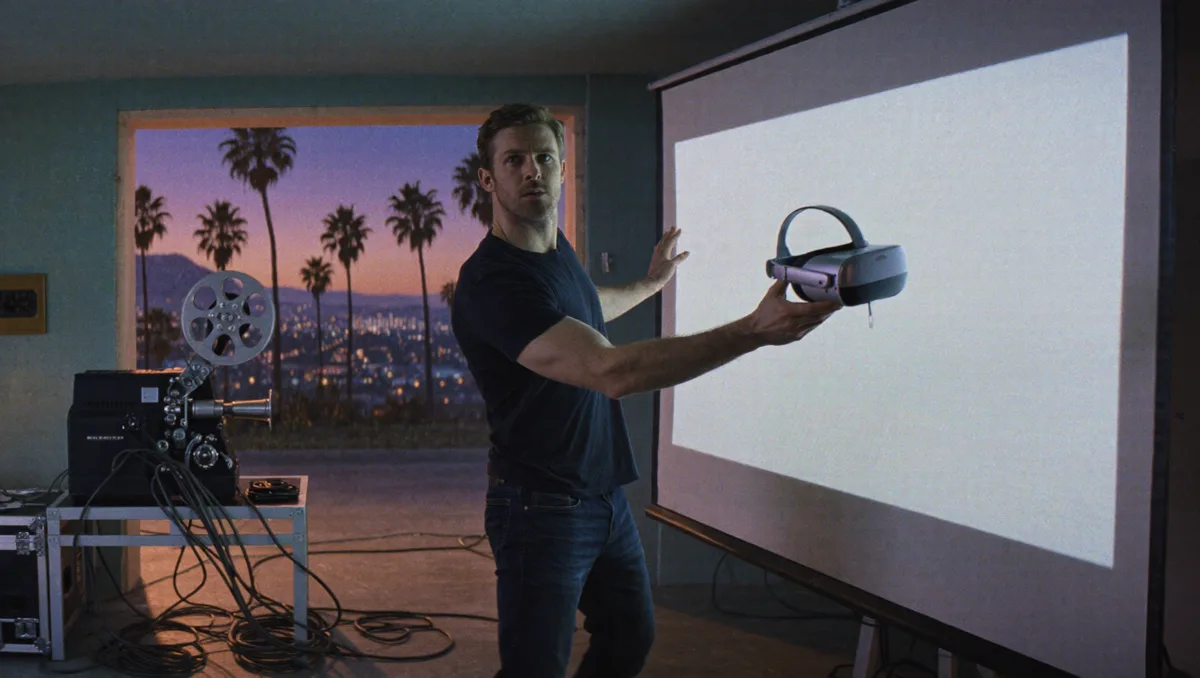
The screen door effect is the faint grid pattern a viewer can see when the gaps between an image's pixels become visible — a picture that looks, in places, as if it is being watched through a porch screen. It appears most often on projectors, which stretch one image across a very large surface, and in virtual reality headsets, which hold magnifying lenses an inch or two from the display. Whether it shows up at all depends on three things: how tightly the pixels are packed, how much of the panel actually lights up, and how far the viewer sits.
The artifact is not a defect in any single device. It is a byproduct of how digital images are built — a grid of square cells, each one a tiny lamp — and of what happens when that grid is made enormous or brought very close to the eye. The name is descriptive rather than technical, and it stuck because the comparison is exact. Once a viewer has seen it, the effect is hard to unsee on an ill-matched setup.
Why does the artifact carry that name at all? According to Cambridge Dictionary, "why" asks for what reason or purpose, and the reason here is plain: early digital projectors displayed an image whose pixel structure resembled the mesh of a screen door, and viewers and reviewers reached for the nearest household object to describe it. The label outlived the hardware that inspired it.
What exactly is the screen door effect?
A digital image is not a continuous picture. It is a lattice of pixels, and between those pixels sit tiny inactive zones — wiring, borders, and the small dead space that separates one light-emitting cell from its neighbor. On a phone screen those zones are far too small for the eye to resolve. Blow the same image up to the size of a wall, or push it toward the eye through a magnifying lens, and the inactive zones grow with everything else. The result is a faint dark grid laid over the picture, most noticeable in bright scenes and flat, uniform colors such as a sky or a title card. Readers following this should also see How Digital Cinema Projection Works: From Encrypted DCP to Laser Light.
Two properties of a display determine how visible that grid becomes. The first is pixel density: more pixels in the same area means smaller cells and thinner gaps. The second is what display engineers call fill factor — the share of the panel's surface that actually produces light rather than sitting dark between cells. A display with a high fill factor hides its structure; one with generous borders around each pixel advertises it.
Why do projectors show it more than TVs?
Projection is an exercise in magnification. A projector's imaging chip is small — in many consumer units, roughly the dimensions of a coin — yet it throws an image across a wall or screen measuring well over a hundred inches diagonally. Every pixel on that chip is stretched thousands of times over in area. The gaps between pixels stretch too, and the viewing distance rarely grows in proportion, because a home viewer sits in the same seat whether the picture comes from a panel or a projector.
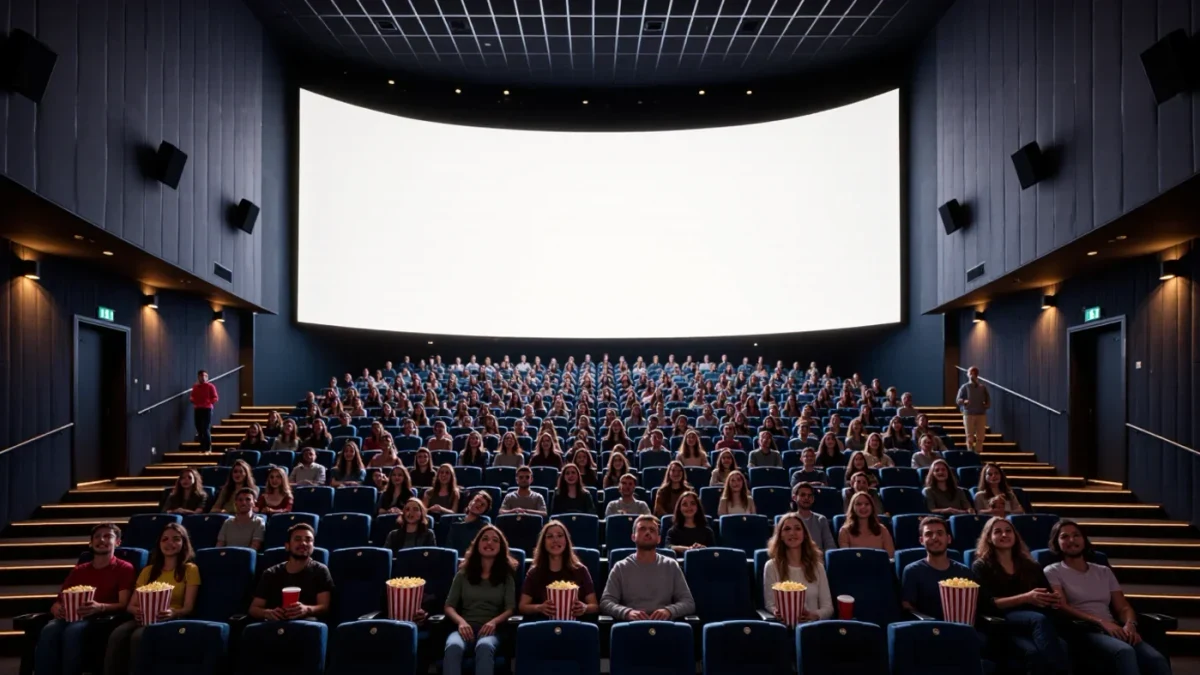
Distance is the quiet variable. The same projected image that shows a visible grid from six feet away can look seamless from twelve, because the eye can no longer separate the individual cells. This is why the effect is a seating-chart problem as much as a hardware problem: in a commercial cinema, the projection booth and the screen are engineered so that even front-row viewers stay beyond the distance where the pixel structure resolves. In a living room, the math is tighter and the compromise more visible.
Why is VR where the effect bites hardest?
A headset is the extreme case of everything above. The display sits a short distance from the eye, and a lens magnifies it again before the light ever arrives. The viewer is effectively pressing their face against the pixel grid, so the inactive zones between cells resolve sharply — historically as a visible black lattice over the virtual world, which is precisely the porch-screen comparison that gave the artifact its name.
Headset makers have attacked the problem from both ends of the pipeline. Higher pixel counts shrink the cells and the gaps together. Improved optics spread each pixel's light more evenly, softening the grid's edges. Some designs add a subtle diffusing layer that blurs the boundaries between adjacent cells at a negligible cost to sharpness. Software has joined in as well: rendering techniques that fill the gaps with interpolated light, and pixel arrangements that avoid the strict square lattice in the first place, both reduce the impression of looking through mesh. None of these fixes is magic; each trades a little of something else — sharpness, brightness, cost — for a smoother field of view.
What actually minimizes the effect?
For a viewer choosing or positioning equipment, the levers are straightforward, and none requires a spec sheet beyond the obvious.
- Sit farther back. Viewing distance is the single cheapest fix. If a faint grid is visible, moving back until it disappears costs nothing and harms nothing else.
- Prefer higher pixel density. A display that packs more pixels into the same image area divides the same gap structure into smaller pieces, pushing the grid below what the eye can separate at a given distance.
- Match screen size to the room. On projection, a smaller image spreads each pixel less, which shortens the distance at which the structure disappears.
- Mind the content. The grid hides in detail and shows itself in flat fields of bright color. It is most conspicuous in animated films, title sequences, and bright sky shots — worth knowing when judging a setup.
One caution belongs here. Manufacturers market resolution heavily, but resolution is only one of the variables above. Fill factor, optics, and viewing distance do as much work, and a spec number alone will not tell a buyer whether the grid will be visible from their couch.
What this means for how films are watched
The screen door effect sits at the intersection of two stories this publication covers often: how images are engineered, and how the presentation shapes what a film actually looks like. A projected picture is never just the movie — it is the movie plus the chain of hardware between the file and the eye. Readers who want the cinema-side version of that chain, from encrypted delivery to the light on the screen, will find it in How Digital Cinema Projection Works: From Encrypted DCP to Laser Light. The same principle applies at home, where compression and bitrate decide a stream's sharpness before the display ever enters the equation; that side of the story is covered in Streaming Video Quality Explained: Why the Same Film Looks Different Everywhere. We covered a connected angle in Streaming Video Quality Explained: Why the Same Film Looks Different Everywhere.
There is also a historical arc worth naming. The artifact was at its most conspicuous in the early generations of digital projection and consumer VR, when pixel counts were modest and magnification was aggressive. As density has risen across both categories, the effect has retreated from a defining flaw to an edge case that surfaces mainly on budget hardware, oversized screens, or unusually close seating. The trend line is one-directional, but it has not yet reached zero — which is why the term remains in circulation among reviewers and enthusiasts.
Our analysis, put plainly: the screen door effect is less a defect than a diagnostic. When it appears, it is telling the viewer that one of the three variables — density, fill factor, or distance — is out of balance for that room and that seat. Fix the imbalance, and the porch screen disappears.
Will the screen door effect ever disappear completely?
In practice, yes, for a given setup — and the route there is not always more pixels. The effect vanishes whenever the pixel structure falls below what the eye can resolve at the actual viewing distance, which can be achieved by higher density, better optics that blur the cell boundaries, or simply more distance between viewer and image. Displays with light-emitting layers that fill nearly the whole panel area have largely closed the gap from the hardware side. What remains is the corner case: extreme magnification, close viewing, or low-cost hardware, where the grid can still surface. The honest answer is that the effect is engineered away setup by setup rather than abolished by any single technology.