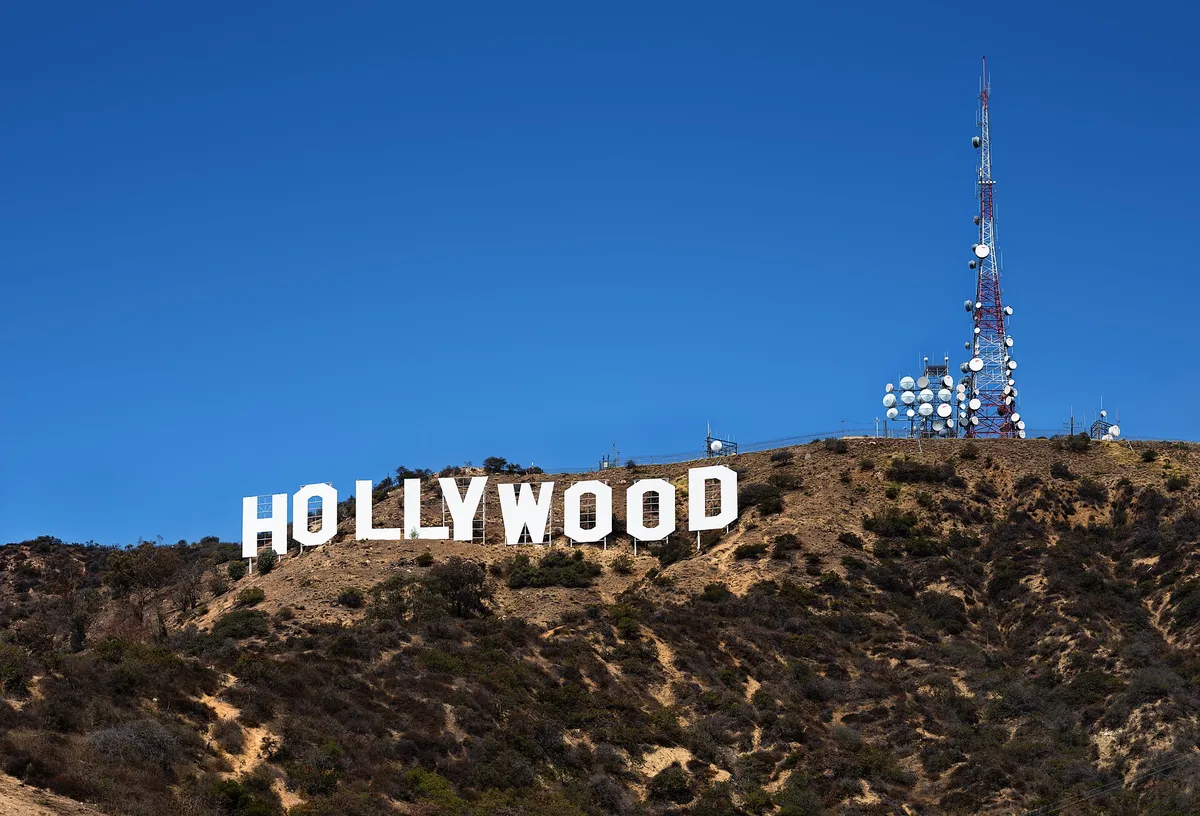
The Hollywood sign was built in 1923 as a real-estate advertisement, not a monument. It originally read "Hollywoodland," promoted new hillside homes, and was expected to stand for about a year and a half. It never came down, and a century of repairs turned a temporary billboard into the most visible symbol of the film industry.
Seeing it well requires a little planning. The sign sits on protected hillside, so there is no trail to its base and no legal way to touch the letters. The good views come from a handful of overlooks and trailheads around the hills, each with a different angle, and each crowded at different hours. This guide pairs the sign's odd history with the practical choices: where to stand, when to go, and what to skip.
The backstory matters because it explains the sign's strange shape and even stranger survival. It was never designed to be beloved. It was designed to sell houses.
Why does the Hollywood sign say what it says?
According to Britannica, the sign was first built in 1923 and originally spelled "Hollywoodland," advertising new homes being developed in the area. Los Angeles Times publisher and real estate developer Harry Chandler put it up, and History places the cost at $21,000 — a serious sum for what was, on paper, a temporary marketing stunt.
The original letters were enormous by any standard: each one 30 feet wide and 43 feet tall, attached to telephone poles and lit by 4,000 light bulbs, per History. A billboard that blinks is a billboard that sells. The plan was to take it down after about eighteen months. Instead it stayed, and the neighborhood it advertised became a footnote while the advertisement became the landmark.
Neglect nearly ended it. The sign deteriorated during the Great Depression, and a partial restoration in 1949 removed the last four letters — the "land" section — leaving the nine letters visible today, Britannica notes. A full replacement followed in the late 1970s, when a new sign was erected after another round of decay. The version on the hill now is a rebuild, which is worth knowing before anyone calls it a 1923 original.
What was Hollywood like when the sign went up?
The sign went up in a district that had only just become the film capital. Britannica dates Hollywood's first studio to a site on Sunset Boulevard in 1911, with roughly 20 companies producing films in the area soon after. By 1915, the district had become the center of the American film industry as independent filmmakers relocated from the East Coast.
The migration had unglamorous causes. History points to weather and terrain, but also to a legal detail: filmmakers could not be sued in California for infringing on the motion-picture film patents held by Thomas Edison and his Motion Picture Patents Company. Distance from Edison's lawyers did as much for the industry as the sunshine did.
The sign, in other words, was advertising homes to people arriving for the movies. The industry and the real estate grew up together, and the hillside letters watched both. For how the business those founders built still works, see How the Hollywood Studio System Still Shapes Franchises, Stars and Streaming Deals. For related coverage, see How the Hollywood Studio System Still Shapes Franchises, Stars and Streaming Deals.
Where are the best viewpoints for the Hollywood sign?
The honest answer: not up close. The sign stands on restricted hillside behind fences and cameras, and rangers do cite people who climb to it. Every good view is from a distance, and distance is what makes the sign readable anyway. Three general options cover most visits.
- Griffith Observatory and Griffith Park. The classic postcard angle. The sign sits across the canyon to the southwest, framed by the observatory's terraces, and the park's trails offer progressively higher vantage points for anyone willing to walk. It is also the easiest option by transit and parking standards, which in Los Angeles is saying something.
- Lake Hollywood and the surrounding residential streets. The reservoir below the sign gives the cleanest head-on view of the letters. Streets around the lake offer similar angles, but they are someone's neighborhood — park legally, keep voices down, and do not block driveways. Residents have fought hard for exactly that courtesy.
- Trailheads on the sign's south and west sides. Several canyon routes climb to ridgelines with side-on or close-range distant views. These are real hikes with sun exposure and no shade to speak of, so water and morning starts are the sensible pattern. The trails are legal; the sign itself is not a destination.
What this means in practice: pick one viewpoint and one backup. The hills look small on a map and take far longer to cross by car than anyone expects.
When should you go, and what should you skip?
Morning is the reliable window. Southern California haze builds through the day, and the sign faces south, so afternoon light flattens the letters into silhouette more often than visitors expect. Clear winter days after rain give the sharpest views of the year. Sunset is beautiful over the city but turns the sign itself into a backlit shape.
Two things to skip. First, any tour or shortcut promising access to the letters — the hillside is closed for a reason, and the fines are real. Second, the scramble for the perfect parking spot on narrow residential streets near trailheads; a longer walk from a legal spot beats a ticket. The sign has survived a century of neglect, a Depression, and a full rebuild. It does not need anyone's drone.
A practical note on expectations: the sign reads best from below and at a distance. Photographs that make it look enormous are usually taken from the reservoir basin or a ridge with a long lens. Up close, from any legal position, it is smaller and farther away than the movies suggest — which is itself a useful thing to know before planning a visit around it.
What else is worth pairing with a sign visit?
The sign overlooks a district with a century of film history attached, and most of it is a short drive away. Griffith Observatory pairs naturally, since the view includes the sign. Hollywood Boulevard adds the Walk of Fame, Grauman's Chinese Theatre with its star handprints in the forecourt, and the restored Egyptian Theatre — Britannica notes the 1922-built Egyptian was fully restored in the 1990s and became home to the American Cinematheque, a nonprofit film-presentation organization. The Hollywood Bowl, used for summertime concerts since 1922 per Britannica, sits in the same hills.
For visitors interested in the district's older layers, the Hollywood Graveyard Guide: How Hollywood Forever Maps the Stars' Final Resting Places covers a cemetery that holds figures from the silent era onward. And for the broader context of the neighborhood the sign advertises, the Hollywood category hub collects the site's coverage of the industry and the place it made famous. This connects to our earlier piece, Hollywood Graveyard Guide: How Hollywood Forever Maps the Stars' Final Resting Places.
The sign's own story is the best argument for the visit. It was a $21,000 advertisement meant to last eighteen months, per History. The houses it sold are long since resold. The ad is still up.
The takeaway: a landmark that outlived its purpose
The evidence supports a simple read: the Hollywood sign is the industry's most durable piece of marketing, promoted by a newspaper publisher, saved by neglect turning into affection, and rebuilt once when affection ran out. Seeing it well takes no special access — just a legal viewpoint, a morning start, and realistic expectations about distance. The history is the bonus. The letters were never meant to matter, and that is exactly why they do.