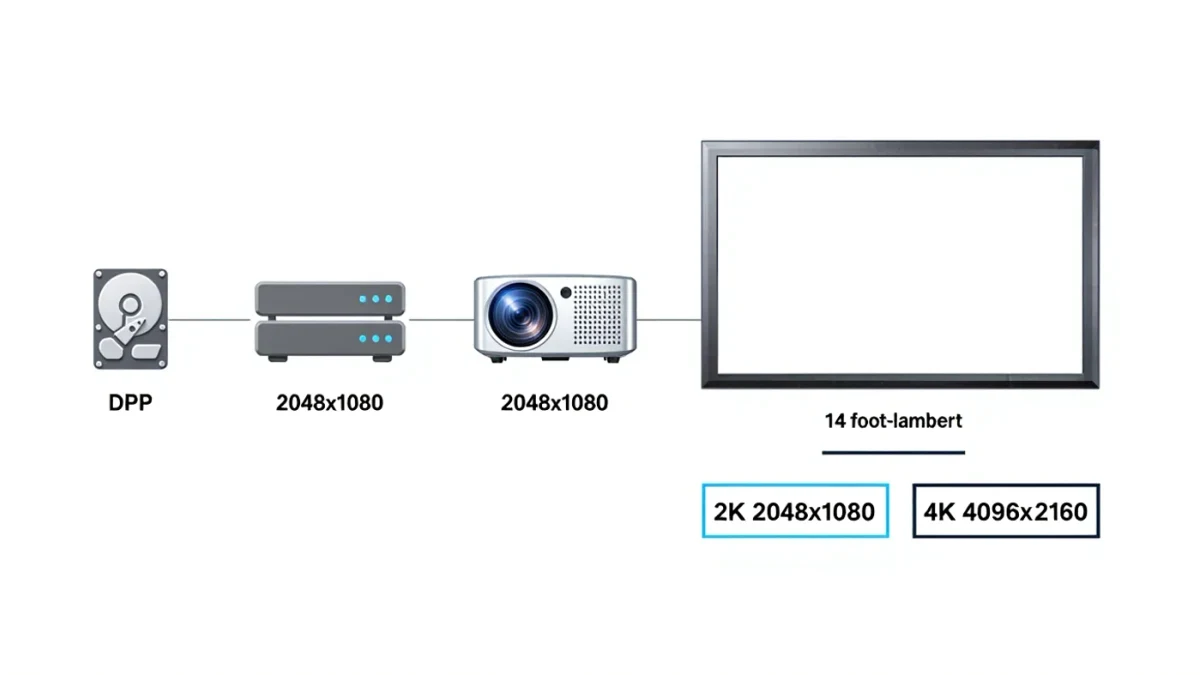
Every film that reaches a modern cinema screen arrives as a Digital Cinema Package, or DCP — a hard drive's worth of encrypted, standardized files that the projector plays back under strict rules set by the Digital Cinema Initiatives consortium in 2005. The standard defines everything from resolution (2048×1080 for 2K, 4096×2160 for 4K) to frame rate and color space. The result is that a movie looks the same in every compliant theater, a uniformity 35mm never achieved after a week of prints wearing out.
What is inside a DCP?
A DCP is a folder structure, not a single file. Inside are MXF-wrapped tracks: one for the picture, one or more for sound, plus subtitle and caption reels. The picture track is JPEG 2000 compressed — roughly 250 megabits per second for 4K — in an XYZ color space wider than the rec.709 used for Blu-ray and broadcast. A small XML file called the Composition Playlist tells the server which tracks make up the movie and in what order; another, the Packing List, verifies integrity.
Encryption is standard practice. Each DCP is locked to a Key Delivery Message, a time-limited digital key tied to a specific server and a specific screening window. If a drive is stolen, it plays nowhere without the KDM — which is why distributors can courier the same physical media worldwide without meaningful piracy risk at the exhibition stage.
How does the projector actually display it?
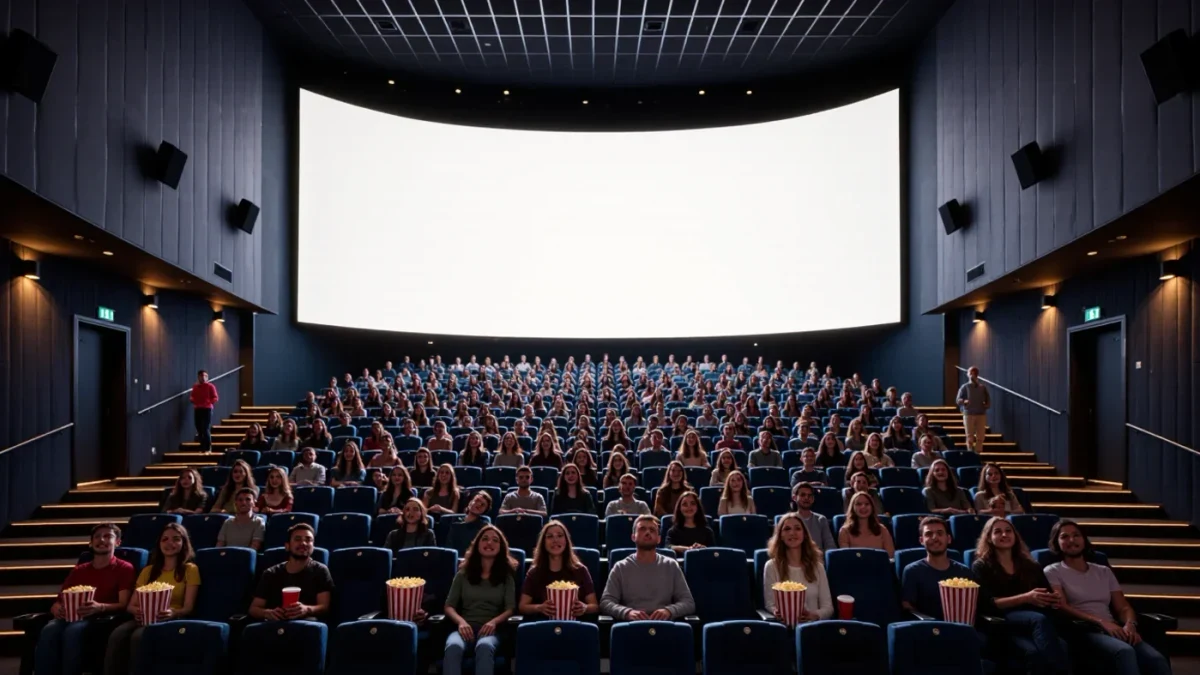
The cinema media server decrypts and decodes the package in real time, then feeds the picture through a series of electronics to the projector head. Nearly all digital cinema projectors use DLP chips from Texas Instruments: a DMD panel with millions of micro-mirrors that tilt toward or away from the lamp. Color comes from a spinning wheel or, in higher-end three-chip designs, from splitting light through a prism to separate red, green and blue panels. Xenon lamps dominated the first digital generation; laser phosphor and RGB laser sources have largely replaced them, cutting power draw and enabling the high brightness and contrast of premium formats.
The projection target is calibrated: 14 foot-lamberts of luminance for a standard house, per DCI's reference. This is the number every premium format advertises beating. A projectionist — or increasingly an automated calibration system — confirms color temperature, uniformity and focus against that reference before a release goes on.
What replaced the projectionist?
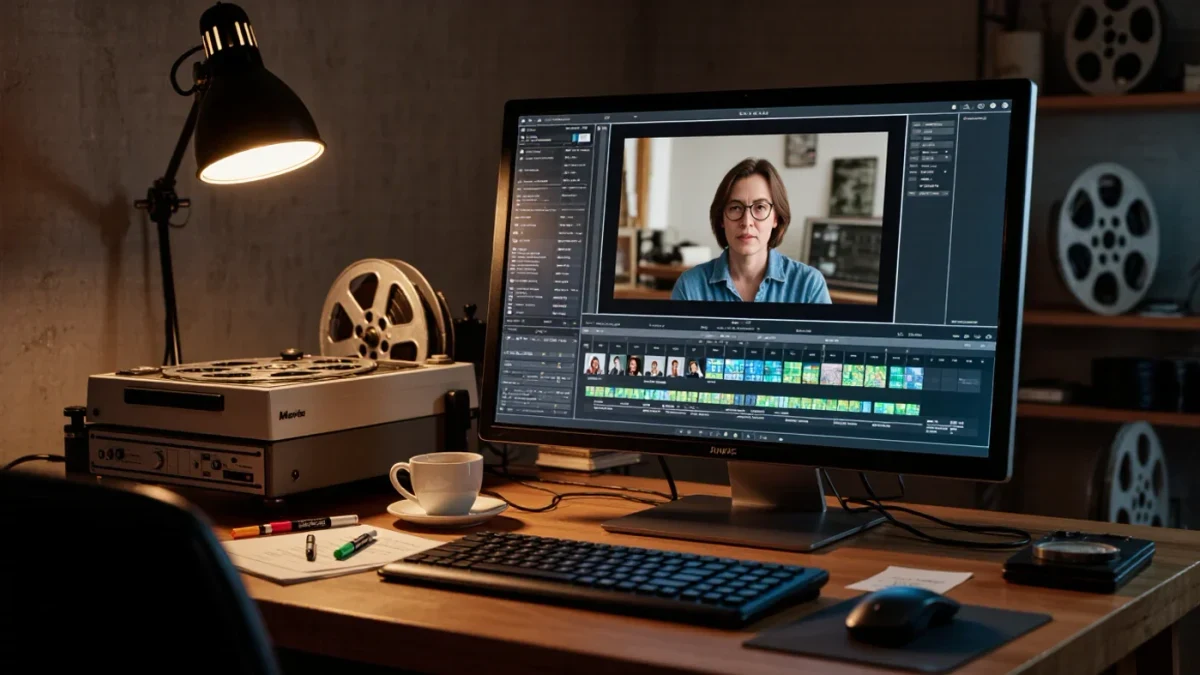
The physical changeover of film reels is gone, and with it much of the craft labor. A digital house ingests the DCP once, schedules it in a theater management system, and the server plays it unattended for the entire run. Faults that once meant a melted frame now mean a failed KDM or a mis ingested reel. The trade is consistency: no scratches, no weave, no prints degrading week over week. The cost is that when something breaks, it often breaks identically in every auditorium until a technician intervenes.
Why do some films still ship on hard drives?
Distribution is moving to satellite and broadband delivery, but physical drives persist because of theater bandwidth and because a DCP can run to hundreds of gigabytes for a 4K feature with multiple audio tracks. The industry's transition is a quiet logistics story: same standard, different pipes.
Does 4K projection actually matter?
It depends on distance and finishing. Most auditoriums seat viewers far enough that 2K and 4K are barely distinguishable; the bigger visible wins of modern projection are brightness stability, laser contrast and the absence of film wear. Where 4K pays off is large screens — IMAX-class walls and premium large formats — where pixel structure and fine detail survive at scale. It is not an accident that the premium formats market their light sources, not their pixel counts, first.
What did the switch replace?
The 35mm regime that digital projection displaced ran on physical prints struck from a negative, each one losing a little fidelity with every screening. A wide release meant thousands of prints, each weighing around 20 kilograms, shipped in cans at meaningful cost and re-collected after the run. Prints scratched, jumped, broke mid-reel and needed changeovers — the craft labor of the projection booth. The industry's conversion, completed in most markets by around 2013, was driven by distribution economics as much as image quality: a DCP costs a fraction of a print to duplicate and ship.
What was lost is subtler. Photochemical projection has a grain structure and a softness many cinematographers still prefer; the digital image is cleaner, sharper and more stable, which reads as a different texture. A minority of filmmakers — Nolan chief among them — have kept photochemical capture and projection alive for exactly that reason, and revival houses now book 70mm and 35mm prints as an event premium.
How does 3D fit in?
Almost all digital 3D is a projection trick layered on the standard pipeline: the DCP carries left-eye and right-eye frames, and the projector alternates them faster than the eye can resolve. Passive systems polarize the two streams and filter them at the glasses; active systems shutter each lens in sync. The cost is brightness — polarized 3D typically throws away well over half the light reaching each eye, which is why 3D shows often look dim and why high-output laser projection made 3D viable again in premium rooms.
What happens when something fails?
Digital faults are categorical rather than gradual. The common failures are administrative: a KDM that hasn't arrived or has expired, a mis-ingested reel, a playlist pointed at the wrong version of the film — the theatrical cut instead of the correct one. Picture quality itself either meets the calibrated reference or the show doesn't run. Audiences notice this as fewer bad screenings but also fewer saved ones; there is no projectionist riding gain on a failing lamp anymore.
What is the frame-rate story?
The DCI standard built its pipeline around 24 frames per second, the photochemical default since the late 1920s, with sanctioned high-frame-rate support up to 48 and 60 fps. Only a handful of productions have used the headroom — Peter Jackson's three Hobbit films at 48 fps remain the largest experiment — and audiences largely rejected the look, which reads as video because motion blur all but disappears. The capability sits in every projector; the industry keeps 24 fps because the audience's idea of cinema is attached to it.