Aspect ratio — the width of the frame divided by its height — is why movies change shape. A century of screen formats traces a single arc: Hollywood standardized a near-square 1.37:1 "Academy ratio" in 1932, panicked into widescreen when television arrived in the 1950s, and settled into today's split between 1.85:1 flat and 2.39:1 scope. Every shift was commercial and technological at once, and every one changed how directors composed shots.
What is aspect ratio, exactly?
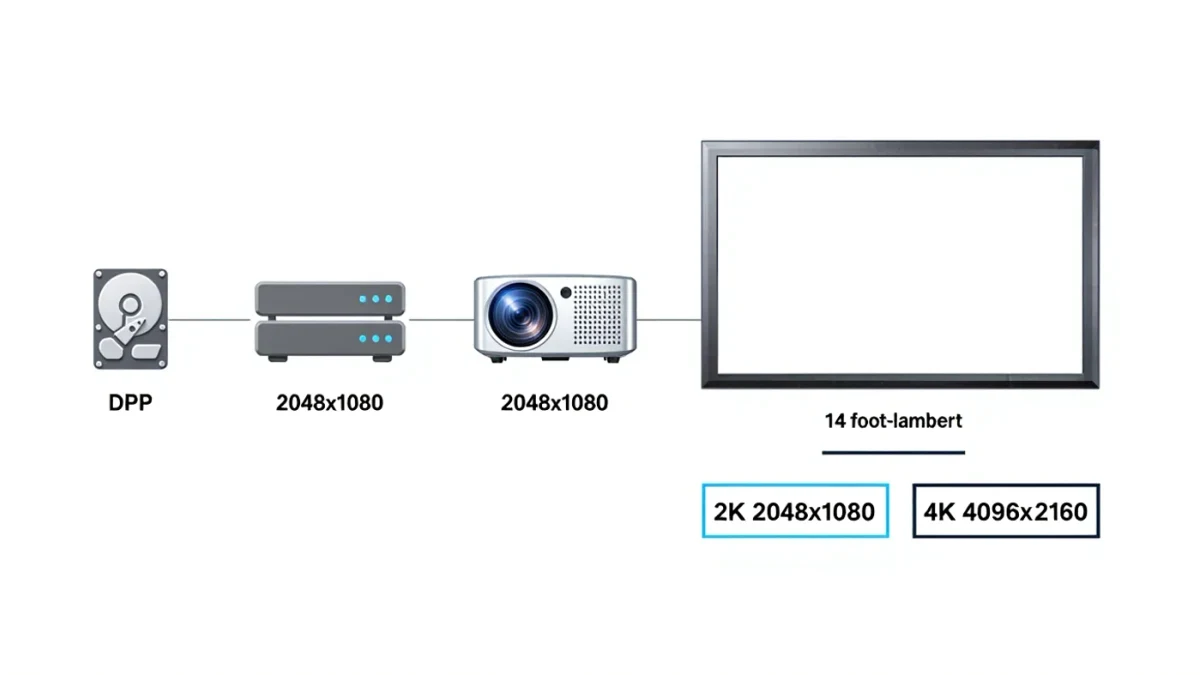
It is pure geometry: 1.85:1 means the frame is 1.85 times as wide as it is tall. The ratio is independent of resolution — a 4096×2160 DCI container and a 1920×1080 HDTV frame both carry the same shapes. What changes between ratios is information: at any fixed height, a wider frame holds more world horizontally and less vertically. Filmmakers choose, or inherit, that trade-off before a single scene is shot, because sets, blocking and lens choices all answer to it.
Projection handles the difference physically. A 2.39:1 film on a 1.85:1 screen plays letterboxed — black bars masking the unused height — while fitting the same image width. That is the honest presentation. The alternatives, cropping the sides or stretching the frame, discard the composition, which is why directors from Steven Spielberg to Christopher Nolan have publicly objected to pan-and-scan home-video versions of their work.
Why did movies get wider?
Sound, ironically, made them narrower first. The optical soundtrack ate into the silent-era frame, and the Academy settled the result at 1.37:1 in 1932. Television then adopted nearly the same shape and gave audiences a reason to stay home. Hollywood's counterattack in the early 1950s was spectacle through geometry: Cinerama wrapped three synchronized projectors around the viewer in 1952, CinemaScope anamorphically squeezed a 2.35:1 image onto 35mm stock for The Robe in 1953, and VistaVision ran film sideways for finer grain. Widescreen was a weapon against the living room, and it worked well enough to become the default grammar.
What do the common ratios look like on screen?
| Ratio | Name | Era and use |
|---|---|---|
| 1.37:1 | Academy ratio | Studio-era standard, 1932 to early 1950s; now an artistic choice |
| 1.66:1 / 1.85:1 | Flat / widescreen | European and American post-1950s default for drama and comedy |
| 2.35:1 / 2.39:1 | Scope | Anamorphic widescreen standard for epics and action |
| 1.43:1 | IMAX film ratio | Near-square giant-screen format; used by Nolan and others |
Why do some modern films switch ratios mid-movie?
Because they mix capture formats. Productions that shoot with IMAX film cameras — The Dark Knight pioneered this in 2008, and Oppenheimer pushed it furthest — alternate between 2.39:1 sequences and expanded 1.43:1 (or 1.90:1 in digital IMAX) footage shot on the larger negative. In an IMAX theater the image visibly grows; in every other auditorium it letterboxes. The ratio becomes a structural device, marking the scenes the filmmakers considered event-scale. Pixar's WALL-E used the reverse trick stylistically decades after the format wars ended — ratio shifts now read as meaning, not just economics.
How does aspect ratio reach your living room?
Streaming and disc deliver the theatrical ratio intact, and modern displays are 16:9 (1.78:1), close enough to 1.85:1 that flat films nearly fill them while scope films letterbox. The friction moved to phones and tablets, where scope films shrink to a horizontal strip. Some platforms and directors have experimented with reframed versions for small screens; most cinephiles and the directors themselves treat the theatrical ratio as the work.
Does the ratio change the storytelling?
Consistently. Wider frames favor landscapes, ensembles, lateral movement and confrontation across space — the Western and the epic adopted scope for a reason. Taller ratios favor faces, vertical architecture and enclosure, which is why intimate dramas and horror often return to 1.37:1 or 4:3: Robert Eggers shot The Lighthouse in near-square 1.19:1 to press its two characters together. Andrea Arnold and Kelly Reichardt have used 4:3 for similar intimacy. The ratio is a viewing distance imposed on the audience, chosen before the first take.
How do anamorphic lenses create scope?
The CinemaScope trick is optical squeeze. An anamorphic lens compresses a wide image onto ordinary 35mm film, and a matching lens on the projector unsqueezes it to 2.35:1 — widescreen from a standard-width print. The format's descendants still define theatrical scope at 2.39:1, and the lenses carry signatures cinematographers chase: horizontal blue streaks from flares, oval bokeh, a breathing quality when focus pulls. Spherical lenses with cropping can hit the same ratio, but the anamorphic look became a genre signifier worth its weight in rental fees.
What was television's answer?
Television standardized 4:3 to match the Academy frame it inherited, then widened to 16:9 — 1.78:1 — in the high-definition era, close enough to 1.85:1 that theatrical flat films nearly fill an HDTV. The near-miss is deliberate format diplomacy: 16:9 was chosen as a compromise between cinema width and broadcast practicality. It also means scope films will always letterbox on consumer displays, and 4:3 archive material pillarboxes. The home screen is a rectangle that fits no era's cinema exactly.
Why did directors fight over full-frame video?
Before widescreen televisions, home video cropped scope films to 4:3 — pan-and-scan, a telecine operator deciding which third of the frame to keep. The practice destroyed compositions built for width, and the fight against it was one of the first public filmmaker-versus-format campaigns: Martin Scorsese and others recorded introductions explaining what the crop removed. Letterboxing won on DVD, and "presented in its original aspect ratio" became a selling point rather than a complaint line. The current echo of that argument is directors opposing croppings and speed-ups on streaming platforms — Netflix conceded director-complaint mechanisms over sped-up playback in 2019.
What about made-for-streaming ratios?
Platforms inherited the theatrical vocabulary rather than inventing one. Netflix and its peers deliver 2.0:1 as a common middle ratio — wider than flat, friendlier to phone screens than scope — and some series shoot 2.0:1 explicitly as a cinematic signal. The phone keeps pulling the other way: vertical video became a native format for short-form content, and a few experimental features have shipped in portrait framing. The grammar is still being negotiated.