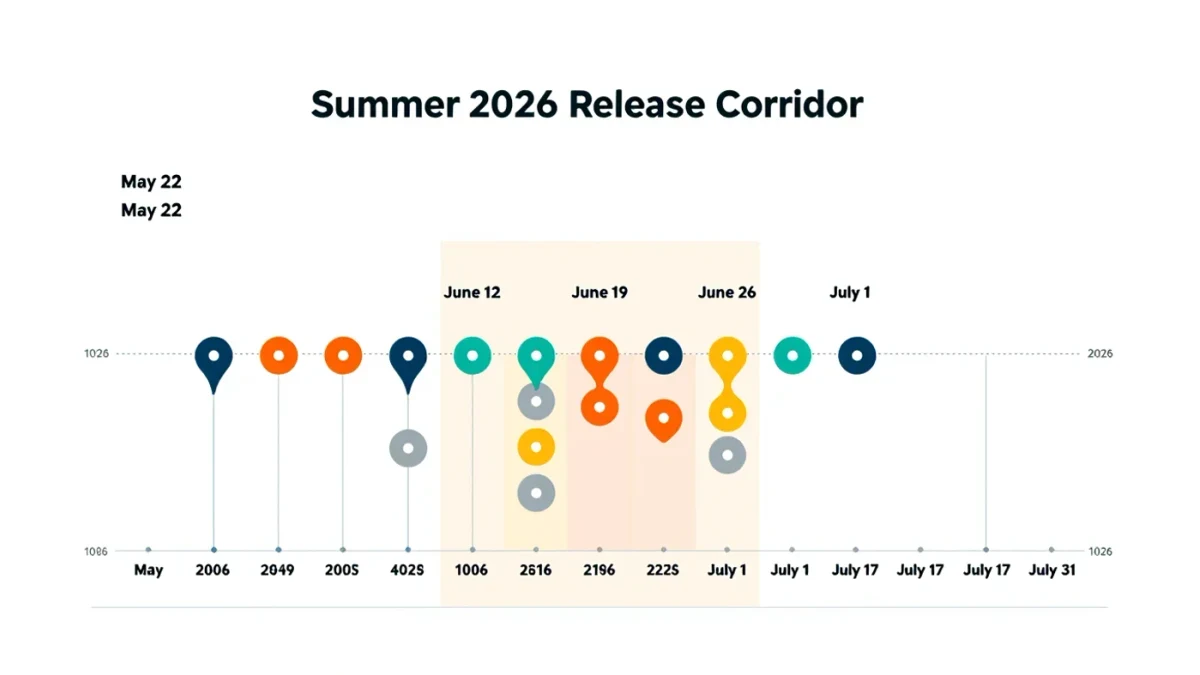
The summer 2026 theatrical slate is set, and its center of gravity is a five-week stretch from late June through July that stacks four event films into adjacent weekends. The season runs from Star Wars' return on May 22 — The Mandalorian and Grogu, the franchise's first theatrical release since December 2019 — through Spider-Man: Brand New Day on July 31, with Steven Spielberg's Disclosure Day on June 12, Pixar's Toy Story 5 on June 19, DC's Supergirl on June 26 and Christopher Nolan's The Odyssey on July 17 packed between them. Per Sony and Marvel's scheduling announcements, Spider-Man: Brand New Day was moved to July 31 after originally holding a July 24 slot, buying distance from Nolan's IMAX-dominated opening a week earlier. The lineup, confirmed through studio release calendars as of January 2026, represents the densest concentration of nine-figure productions in a single corridor since before the pandemic.
How does the summer open?
May belongs to Disney in two configurations. The Devil Wears Prada 2 arrives May 1 as the sequel to the 2006 hit, a female-skewing counter-programmer positioned before the spectacle season begins in earnest. The Memorial Day weekend anchor is The Mandalorian and Grogu on May 22, directed by Jon Favreau — the first Star Wars theatrical film in over six years and the test of whether the franchise's streaming-era popularity converts back into box-office gravity. Lucasfilm has bet its theatrical relaunch on a small-screen-proven property rather than a new saga installment, which makes the opening a referendum on strategy as much as on the film.
What happens in June?
June is a four-studio collision. Universal opens Steven Spielberg's Disclosure Day on June 12, per Universal's release calendar — an original science-fiction event film starring Emily Blunt, Josh O'Connor and Colin Firth, and the summer's only original tentpole concept among the franchise entries. A week later, Pixar's Toy Story 5 claims June 19, the animation division's second theatrical release of the cycle after its 2025 rebound year. On June 26, Warner Bros. opens Supergirl, starring Milly Alcock and directed by Craig Gillespie, as DC Studios' first solo female-led film of its rebooted slate and the direct follow-up test to the 2025 Superman relaunch.
The gamble embedded in that sequence is cannibalization. Four event films in four consecutive weekends, three of them franchise IP aimed at overlapping family and genre audiences, leaves minimal recovery room. Each title needs a second and third weekend to build its multiplier, and the calendar gives none of them a clear runway. Exhibitors benefit from aggregate volume; the studios involved accept compressed legs as the cost of holding claimed dates.
Why is July the highest-stakes month?
Because Christopher Nolan is in it. The Odyssey, opening July 17 per Universal's announcement, is Nolan's first film since Oppenheimer and his second with the studio — an IMAX-shot Homer adaptation with a reported ensemble including Matt Damon, Tom Holland, Anne Hathaway, Zendaya and Charlize Theron. Nolan's release pattern is the industry's most predictable premium-format event: his films command exclusive large-format runs for weeks, which is precisely why the surrounding calendar reshuffled. Spider-Man: Brand New Day, per Sony and Marvel's scheduling, moved from July 24 to July 31 — a two-week buffer after the Nolan epic rather than one. The Sony-Marvel co-production stars Tom Holland and is directed by Destin Daniel Cretton.
That July 17-31 pairing is the summer's box-office centerpiece. An auteur-driven original epic and the marquee superhero franchise sharing one month, with a Shrek sequel — Shrek 5, dated July 1 by Universal — wedged in between, makes July 2026 a stress test of whether the theatrical market can support three event-scale releases in four weeks without a high-profile casualty.
What are the stakes by studio?
Disney has the most exposure and the most to prove: The Mandalorian and Grogu must validate Star Wars as a theatrical property again, while Toy Story 5 must confirm that Pixar's 2025 recovery was structural rather than a one-summer anomaly. Warner Bros. needs Supergirl to extend the DC Studios rebuild beyond its first Superman cycle. Universal has the most diversified position — an original auteur tentpole, the Spielberg film, and the franchise hedge of Shrek — and the least dependence on any single opening. Sony's stake is concentrated in Spider-Man: Brand New Day, the standout asset in a theatrical slate otherwise light on event-scale original properties.
The season also carries one original-film experiment worth isolating: Disclosure Day is the only summer tentpole built on wholly new IP, from the industry's most commercially reliable director. If an original Spielberg event film cannot hold premium theatrical real estate in a franchise summer, the lesson studios will draw about original tentpoles generally is not encouraging.
What could still change?
Little, at this stage. The dates above were locked through studio scheduling calendars as of mid-January 2026, with production on the principal titles completed or in final post. The remaining variables are performance-driven: strong openings extend runs and squeeze neighbors, while a soft launch accelerates the PVOD hop for underperforming titles. The summer's shape is fixed; its ranking is not. The corridor from May 22 to July 31 now contains the majority of the year's projected domestic gross, and the order in which those films finish will define the 2026 market share race through the December 18 release of Avengers: Doomsday — a fourth-quarter event that makes summer's performance a preamble rather than a conclusion.
What does the summer mean for the full-year market?
Summer carries disproportionate weight in the annual domestic total, and 2026's concentration raises the stakes of every individual opening. The corridor from Memorial Day to the first week of August will account for the largest share of the year's gross, which means the season's aggregate performance effectively sets the ceiling on the annual number before the fourth quarter begins. Exhibitors have programmed accordingly — premium-screen allocations, staffing and concession planning all key off the May-July density — and the IMAX commitments around The Odyssey in particular will occupy the format's inventory for weeks, structuring what neighboring titles can claim.
The season also functions as the market-share scoreboard's first half. Disney enters with the most shots on goal, Warner Bros. and Universal each hold genuine event-scale positions, and Sony's year leans heavily on one July title. A single over-performance can reorder that ranking — the 2025 summer demonstrated how quickly a breakout rewrites relative studio standings — and the 2026 corridor, with four event films in adjacent weekends, multiplies the number of variables. The market-share race will not be decided here, but the leaders will be.
What should audiences and the trade read into the lineup's density?
Density is the strategy, not a scheduling accident. Studios held these dates because the alternative — ceding a premium summer weekend to a rival — costs more than cannibalization risk does under current modeling. The audience-side consequence is a cadence of one event film per week for nearly two months, a pace that historically drains the walk-up audience by August and makes late-summer holdovers vulnerable. The trade-side consequence is that second-weekend holds become the season's decisive statistic: with openings largely predictable from tracking, what separates the year's winners from its casualties is how each film retains its audience against a fresh tentpole arriving every seven days. Watch the declines in late June and July, not the debuts.