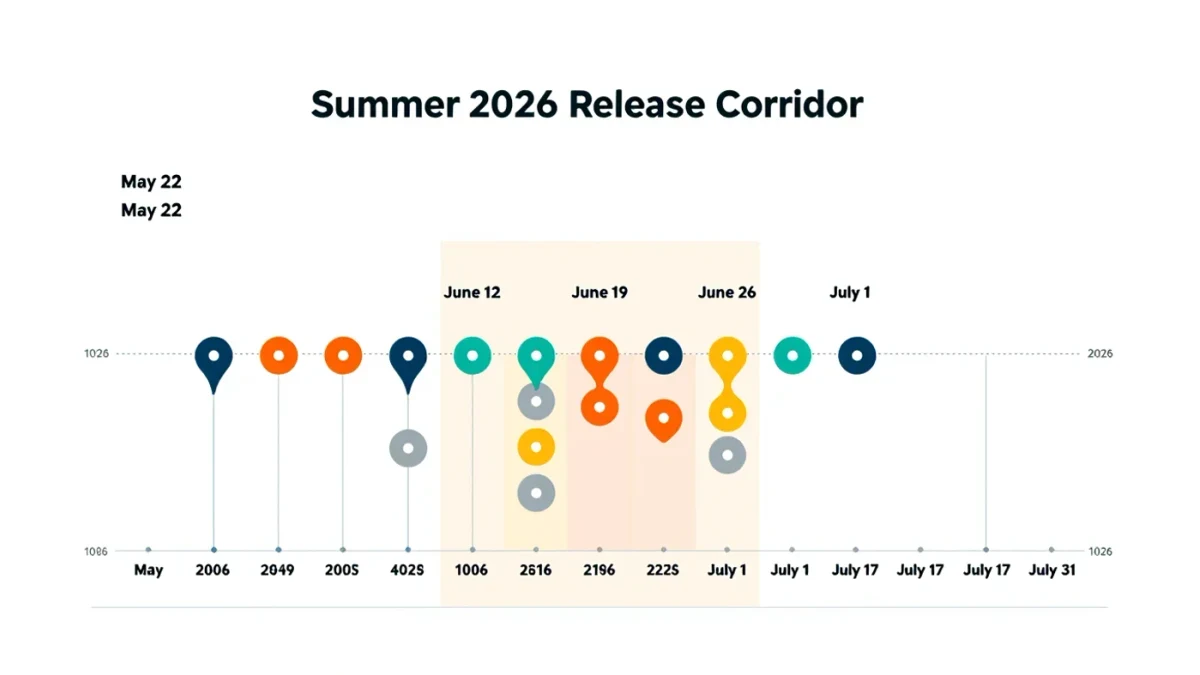
The 2026 release calendar is built around roughly a dozen weekends that studios claimed years in advance, and the pattern is now fixed: Disney opens the summer with The Mandalorian and Grogu on May 22, Pixar holds June 19 for Toy Story 5, Universal counter-programs with Steven Spielberg's Disclosure Day on June 12, and the whole year funnels toward Avengers: Doomsday on December 18. Those dates, announced through standard studio scheduling notices, are the load-bearing beams of the slate. Everything else on the calendar positions itself around them.
Why does the calendar matter more than the movies?
In modern studio economics, a release date is an asset. Major franchises claim prime real estate two to three years ahead of production, sometimes before a script exists. The studio is not scheduling a film; it is claiming a weekend, signaling confidence to exhibitors, and daring competitors to move. When Disney planted Avengers: Doomsday on December 18, 2026 — after shifting it from its original May slot — the move re-sorted the plans of every rival with a fourth-quarter tentpole.
The mechanics are straightforward. There are only a handful of weekends that historically support a $100 million-plus domestic opening: mid-May through mid-July, the Thanksgiving corridor, and the two weeks before Christmas. Studios queue their biggest bets into those windows and fill the rest of the year with mid-budget genre films, animated holdovers and awards contenders. The 2026 calendar follows that logic almost textbook.
What are the anchor dates of summer 2026?
The season opens early. The Devil Wears Prada 2 arrives May 1, giving Disney's 20th Century a female-skewing counter-programmer before the action titles arrive. Memorial Day weekend belongs to The Mandalorian and Grogu on May 22, the first Star Wars film in theaters since 2019 and the test of whether the franchise can still open a theatrical window on its own.
June is a four-way collision. Universal deploys Spielberg's Disclosure Day on June 12 — an original science-fiction thriller in a summer otherwise dominated by IP, per Universal's scheduling announcements. Pixar answers with Toy Story 5 on June 19, and Warner Bros. positions Supergirl on June 26 as the DC Studios follow-up to its 2025 Superman relaunch.
July carries the heaviest concentration of event films in recent memory. Christopher Nolan's The Odyssey opens July 17 on Universal's dime, an IMAX-scaled Homer adaptation that already forced neighboring titles to shuffle. Spider-Man: Brand New Day follows on July 31, after Sony and Marvel Studios moved it off its earlier July 24 slot — itself a one-week buffer from Nolan's film. Two weeks between an auteur-driven epic and the biggest superhero property on the board is the kind of compression that defines the entire year.
Which fourth-quarter dates carry the most risk?
Thanksgiving and Christmas are the second premium corridor. Avengers: Doomsday on December 18 is the single biggest swing of the slate: a Russo brothers-directed ensemble with Robert Downey Jr. returning to Marvel as Doctor Doom, positioned as the pivot point of the Marvel Cinematic Universe's next phase. Lionsgate's Hunger Games prequel, Sunrise on the Reaping, holds November 20, giving the holiday corridor a proven YA franchise ahead of the Marvel behemoth.
The risk in stacking the fourth quarter is cannibalization. A tentpole needs three to four clean weekends to accumulate its multiplier, and December releases compete directly with holiday travel, family schedules and each other. Studios accept that risk because the Christmas corridor reliably delivers the year's best legs when a film connects.
How do the non-tentpole slots fill in?
Around the anchors, the calendar fills with deliberate counter-programming. Horror titles claim the weekends adjacent to big genre films, aiming at audiences the tentpole is not serving. Animated releases spread across March and the early-summer shoulder, when school schedules still support weekday matinees. Adult dramas and awards hopefuls hold their fire until October and November, when critical reception can build a platform release into a December wide break.
The 2026 slate also reflects two structural shifts worth tracking. First, the interval between theatrical and streaming release has stabilized at a shorter window than the pre-2020 norm, which changes how studios value opening weekends relative to total run. Second, the middle of the calendar — February, April, September — has been re-colonized by mid-budget films that studios once exiled to streaming, because the theatrical math on a $30-60 million production works again.
What should trade watchers monitor as the year unfolds?
Three things move a locked calendar: production delays, competitive shifts and test-screening results. When a rival claims a date adjacent to yours, the options are to hold, to swap to a clear weekend, or to concede the corridor entirely. Each move telegraphs the studio's internal confidence in the film. Watch the dominoes around July 17 and December 18 in particular — any slippage by The Odyssey or Avengers: Doomsday would trigger a cascade of rescheduling across the second half of the year.
The 2026 calendar, in short, is a map of studio strategy drawn in dates. May 22 tests Star Wars. June 12 tests whether an original film by the industry's most bankable director can survive a franchise summer. July 17 and July 31 test whether two event films can share one month. December 18 tests the durability of the Marvel model itself. The films will be judged on their merits eventually, but the calendar has already determined the conditions of that judgment.
How do holidays shape the calendar's dead zones?
The calendar's quiet stretches are as deliberate as its congestion. Late August through September is the traditional cool-down corridor, when the summer audience has been harvested and studios release genre holdovers and titles they acquired without awards ambition. Early winter is similarly strategic: January and February sit outside prestige season and outside summer, which makes them the natural home for films a studio is contractually releasing but not aggressively supporting — and, in recent years, for counter-programming surprises that over-perform against low expectations.
March has been re-priced upward as a launchpad. Several of the biggest March openings in history demonstrated that the month can carry a tentpole when the summer corridor is full, and studios now treat mid-March as a legitimate premium slot rather than a placeholder. October belongs to horror, anchored to the Halloween season with the reliability of a retail holiday. November splits between awards platform launches and the family-animated Thanksgiving entry. The annual shape, in other words, is not an accident of scheduling but a demand map: audiences move in predictable seasonal patterns, and the calendar is drawn to follow them.
What role do film festivals play in the calendar?
Festivals function as the calendar's qualification system. The fall circuit — Venice, Telluride, Toronto, followed by New York and London — is where awards contenders debut, because a festival premiere generates the critical consensus and press attention that a platform release needs to build momentum into December. A festival date is therefore a scheduling decision with commercial consequences: premiering too early risks losing momentum by awards season, too late risks missing the conversation entirely. Studios coordinate festival premieres with theatrical platform dates weeks apart, treating the festival as the first exhibition window for prestige product. For trade readers, the festival lineups announced in late summer are effectively a preview of the second-half release calendar's serious contenders.